
-
All Products
- Hydraulic Power Systems & Components
- Shop all
- Hydraulic Pumps & Accessories
- Hydraulic Motors & Accessories
- Hydrostatic Transmissions
- Cylinders & Accessories
- Steering Units & Accessories
- Hydraulic Valves & Accessories
- Shop all
- Ball Valves
- Check Valves
- Check Valves (Pilot-Operated)
- Counterbalance Valves (Overcenter Valves)
- Cushion Valves (Double Relief Valves)
- Directional Control Valves
- Flow Control Valves
- Flow Divider Valves
- Gate Valves
- Logic Element Valves
- Needle Valves
- Plug Valves
- Pressure Reducing Valves
- Relief Valves
- Sandwich Valves
- Premium Selector Valves
- Slip-In Cartridge Valves
- Premium Stack Valves
- System Accessory Valves
- Premium Truck Valves
- Valve Accessories
- Electronic Control Components
- Pressure Sequence Valves
- Screw-In Cartridge Valves
- Motion Control Valves
- Shop Logic Element Valves
- Unloading Valves
- Drain Valves
- Hydraulic Filters & Accessories
- Power Units
- System Accessories
- High Force Hydraulics
- Pneumatic Power & Control
- Shop all
- Pneumatic Cylinders
- Pneumatic Valves & Accessories
- Pneumatic Air Line Filter, Regulator, & Lubicator (FRL's)
- Pneumatic Air Line Filters
- Premium Air Tool Hose Assemblies
- Air Line Lubricating Oil
- Safety Pop-Off Valves
- Pneumatic Air Line Filter & Regulator
- Pneumatic Air Line Filter Accessories
- Pneumatic Air Line Lubricators
- Pneumatic Air Tools
- Pneumatic Air Line Filter, Regulator, & Lubricator (FRL's)
- Pneumatic Air Line Regulators
- Pneumatic Cylinder Accessories
- Fluid Conveying
- Shop all
- Hose Products
- Tubing Products
- Piping Products
- Adapters
- Shop all
- Steel
- Shop all
- O-Ring Face Seal Braze Adapters
- O-Ring Face Seal To Straight Thread O-Ring
- O-Ring Face Seal To Pipe
- O-Ring Face Seal To 37° Flare
- O-Ring Face Seal To O-Ring Face Seal
- O-Ring Face Seal Accessories
- Pipe To Pipe
- Pipe to 37° Flare
- Pipe To Straight Thread O-Ring
- Pipe To Hose
- 37° Flare Union
- Straight Thread O-Ring to 37° Flare
- Straight Thread O-Ring to Straight Thread O-Ring
- Straight Thread O-Ring to Hose
- SAE Split Flange To 37° Flare
- SAE Split Flange To O-Ring Face Seal
- Braze & Weld to 37° Flare
- 42° Inverted Flare to 37° Flare
- Restrictor
- Metric to 37° Flare
- Metric to Pipe
- Metric
- BSPP to 37° Flare
- BSPP to Pipe
- BSPP to Metric
- BSPP to BSPT
- BSPP
- BSPT To Pipe
- BSPT To 37° Flare
- JIS
- JIS 30° Seat (BSPP Thread) To 37° Flare
- Komatsu, Kobelco
- BSPP to 37 deg Flare
- BSPT To JIS
- 37 deg Flare Union
- Pipe to 37 deg Flare
- Straight Thread O-Ring to 37 deg Flare
- O-Ring Face Seal To BSPP
- SAE Split Flange To 37 deg Flare
- Straight Thread O-Ring to Metric
- Metric to 37 deg Flare
- Straight Thread O-Ring to Pipe
- 37 deg Flare Plug
- BSPT To 37 deg Flare
- JIS 30 deg Seat (BSPP Thread) To 37 deg Flare
- O-Ring Face Seal To JIS
- Straight Thread O-Ring to BSPP
- O-Ring Face Seal To Metric
- SAE Split Flange To Pipe
- Auxiliary Components
- O-Ring Face Seal To 37 deg Flare
- Straight Thread O-Ring to JIS
- Braze & Weld to 37 deg Flare
- Metric to BSPT
- Pipe To STC (Snap to Connect)
- BSPP To Hose
- Flareless Fittings
- Braze & Weld to Pipe
- SAE Split Flange To SAE Split Flange
- SAE Split Flange To Straight Thread O-Ring
- 42 deg Inverted Flare Union & Accessories
- Push-to-Connect To STC (Snap to Connect)
- O-Ring Face Seal To STC (Snap to Connect)
- BSPT
- Pipe To 30 deg Flare
- SAE Split Flange Braze Adapters
- BSPT To Hose
- 42 deg Inverted Flare to 37 deg Flare
- Push-On to 37 deg Flare
- O-Ring Face Seal To Hose
- Stainless Steel
- Shop all
- Pipe To Pipe
- Pipe To 37° Flare
- 37° Flare Union
- Straight Thread O-Ring To 37° Flare
- Metric To 37° Flare
- BSPP To 37° Flare
- Auxiliary Components
- Metric
- BSPP
- 37 deg Flare Union
- BSPP To Pipe
- Straight Thread O-Ring To Pipe
- Pipe To 37 deg Flare
- BSPP To 37 deg Flare
- Metric To Pipe
- Metric To 37 deg Flare
- BSPP To Metric
- O-Ring Face Seal To Pipe
- Straight Thread O-Ring To 37 deg Flare
- BSPT To 37 deg Flare
- O-Ring Face Seal To Straight Thread O-Ring
- Straight Thread O-Ring To Straight Thread O-Ring
- SAE Split Flange To 37 deg Flare
- Pipe To Hose
- 37 deg Flare To Hose
- O-Ring Face Seal To O-Ring Face Seal
- 37 deg Flare Plug
- Straight Thread O-Ring To BSPP
- Braze & Weld to Pipe
- Metric to BSPT
- BSPT To Pipe
- BSPT
- Brass
- Shop all
- Pipe To Pipe
- Pipe To 37° Flare
- Pipe To 45° Flare
- 45° Flare Union
- 42° Inverted Flare To 45° Flare
- 42° Inverted Flare To Pipe
- 42° Inverted Flare Unions & Accessories
- Garden Hose Adapters
- Pipe To 45 deg Flare
- Braze & Weld to Pipe
- 42 deg Inverted Flare To Pipe
- 45 deg Flare Union
- BSPP
- 45 deg Inverted Flare Union
- Pipe To 37 deg Flare
- 37 deg Flare Union
- Pipe To Hose
- BSPP To Pipe
- 37 deg Flare To Hose
- BSPT To Hose
- 42 deg Inverted Flare To 37 deg Flare
- 45 deg Flare To Hose
- 45 deg Inverted Flare To Pipe
- BSPT
- 45 deg Inverted Flare To Hose
- BSPP to BSPT
- 37 deg Flare Plug
- 45 deg Inverted Flare To Tube
- O-Ring Face Seal Braze Adapters
- BSPP To Hose
- BSPT To Pipe
- Metric to Flare
- BSPT To 45 deg Flare
- Metric
- Metric To Pipe
- Stainless Steel Steel
- Hydraulic Quick Disconnects
- Miscellaneous Fluid Conveying Parts
- Shop all
- Flanges
- Metric & BSP Seals & Washers
- Protective Closures
- Split Flange Kits & O-Rings
- Support Clamps
- Swivel Joints
- Air Brake Products
- Hose, Tube & Pipe Cleaning System
- Flange Accessories
- Hose, Tube & Pipe Cleaning System Accessories
- Brake Hose Accessories
- Hose Accessories
- Support Clamp Accessories
- Fitting Assortments
- Performance Parts
- Shop all
- Hose
- Adapters
- Brake System Adapters
- Fuel System Components
- Couplings
- PRO CLAMP and Overbraid
- Accessories
- Reusable Fittings for AQP & Starlite Racing Hose
- Crimp Fittings for AQP & Starlite Racing Hose
- Fittings for AQP Socketless Hose
- Reusable Fittings for Aeroquip FBF A/C Hose
- Fittings for Teflon Racing Hose
- Reusable Fittings for AQP High Pressure Hose
- Assembly Equipment
- Hydraulic Brake Components
- Other Products
- Shop all
- Hydraulic Fluids & Oils for Industrial Systems
- Seals
- Industrial Chemical Maintenance Products
- Lubrication Equipment & Accessories
- Fasteners
- Valves
- Couplings
- Bearings
- Control Cables
- Thread Sealants
- Gloves
- Hand Tools
- Pressure Washer Products for Industrial & Commercial Use
- Hose Reels
- Winches
- Cable Hardware & Knobs
- Cable Remote Controls
- Industrial Corrosion Inhibitors
- Y Strainer
- Hose Nozzles
- Textbooks
- Cable (Wire) Ties
- Piston Vibrators
- Software Licenses
- Human Machine Interface & Accessories
- Safety Glasses
- Hydraulic Punches & Dies
- Thread Sealant Tapes
- Identification Tools
- Gasket Makers
- Threadlockers
- Tool Storage
- Temperature Controllers & Accessories
- Brazing Rods
- Gear Drives & Accessories
- Gauges
- Drill Bits
- Paint Markers
- Switches & Accessories
- Power Tools
- Cut-Off Wheels
- Work Lights
- Cleaning Cloths & Towels
- Hose Reel Accessories
- Labels
- Flashlights
- Shirts
- Pipe Wrapping Tapes
- Batteries
- Winch Parts & Accessories
- Pen Lights
- Hydraulic Power Systems & Components
-
Services
- 24/7 On-Site Mobile Services
- Control Cable Assemblies
- Crimper Maintenance Program
- Custom Hydraulic Components Fabrication
- Cut & Weld
- Danfoss x20 Stock Change Program
- Engineering Center Services
- Hose Kitting Services
- HPU Build Program
- Hydraulic & Industrial Hose Assemblies
- Hydraulic Repair & Service
- Tube Bending Services
- Vane Pump Build Program
- View All Services
- Branch Locations
- Catalogs
- Help
- Quick Order
SAME DAY SHIPPING
— Order by 2pm EST.
Tube Bending Services
Fabricated to Print, Verified to Spec, Built to Eliminate Leak Points
HSC produces precision-formed steel and stainless tube runs built to your drawing, routing, and pressure class. We bend, end-form, clean, and verify in-house — backed by our Engineering Center since 1947 — so you replace error-prone field bends with documented, repeatable parts.
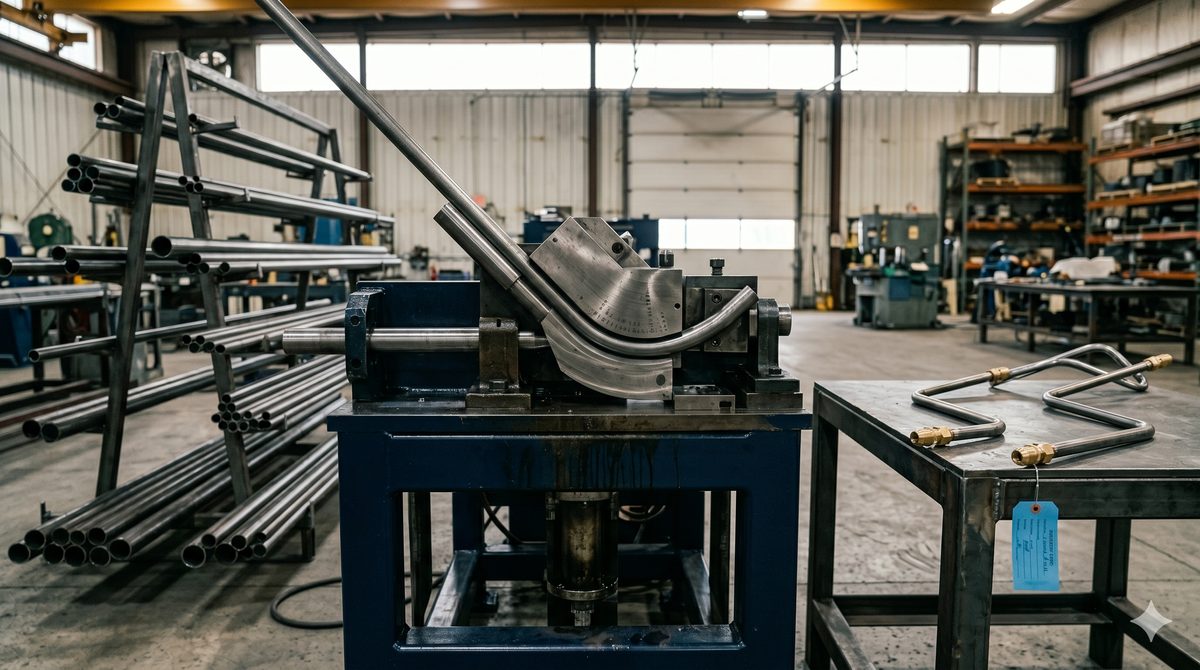
TUBE BENDING SCOPE
What Our Tube Bending Services Cover
Tube bending is a coordinated set of operations — material selection, bending, end forming, cleaning, and inspection — that turns straight tube into a finished hydraulic conductor ready to install. We handle one-off replacement runs and repeatable OEM production runs.
Common work includes:
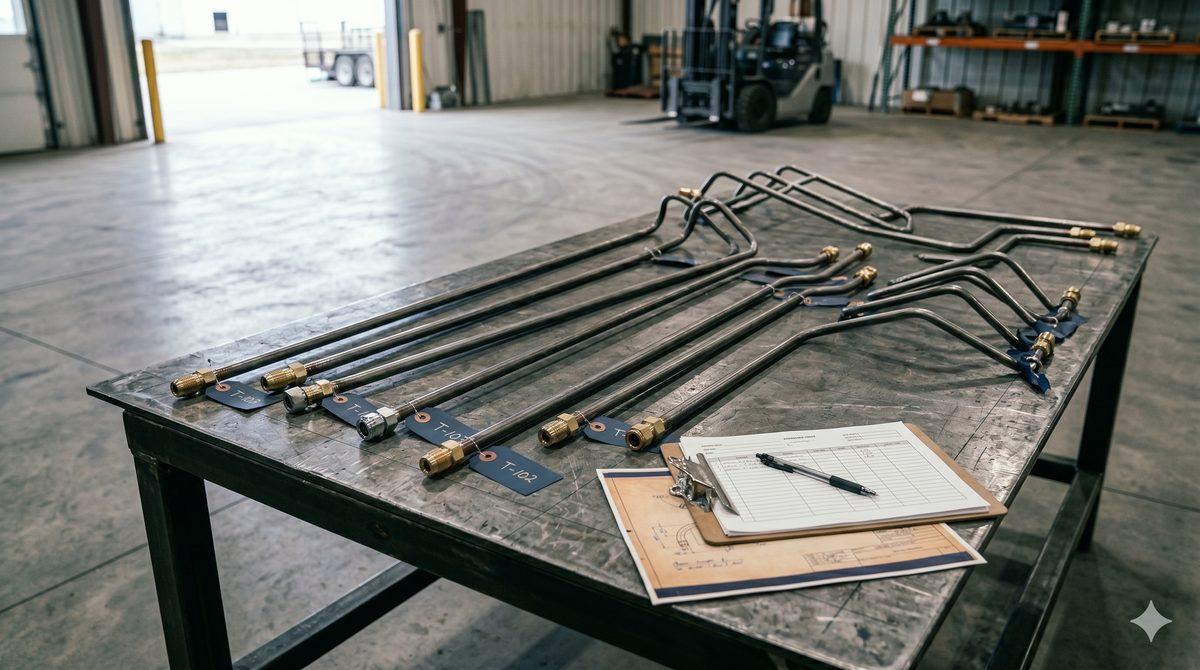
Documented, Repeatable Builds
Documented setups and full traceability across every unit — the hundredth assembly installs the same way as the first, whether OEM, MRO, or service.
Inspected Against Print
Critical runs are dimensionally inspected against drawings before shipment — what arrives at your dock is verified, not something your installer has to rework.
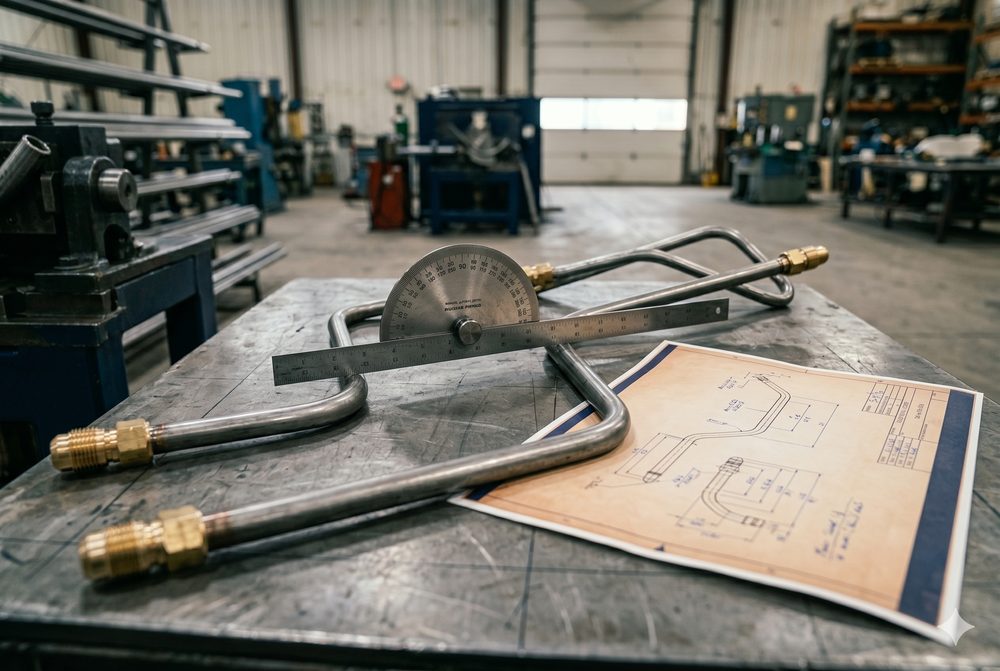
BUILT TO SPEC
Built to Spec, Inspected Before It Ships
Every tube run starts with confirmed requirements before the first bend. Material, wall thickness, and bend radius are driven by the pressure, flow, and duty cycle the line will see — getting them right at the bench is cheaper than diagnosing a cracked flare in the field.
We build from:
- Operating pressure and flow, including peak and continuous duty
- Tube material and wall thickness for the fluid, pressure class, and environment
- Bend angles, centerline radii, leg lengths, and clocking per your drawing
- Routing, support, and clearance in the installed envelope
- Cleanliness requirements for the system
From there, we bend, end-form, deburr, and clean to those locked specifications. Critical runs are dimensionally checked against the drawing before shipment, so what arrives at your dock is verified.
REAL-WORLD APPLICATIONS
Where Precision Tube Bending Earns Its Keep
After two decades of building and troubleshooting hydraulic systems, the pattern holds: well-bent tube pays off wherever a system has been compensating for too many fittings, wrong routing, or field bends.
Production Hydraulic Equipment
Repeatable, drawing-controlled tube runs across units instead of one-off field bends — the hundredth assembly installs the same way as the first.
Service & Repair on Existing Machinery
Recreate a damaged or obsolete factory tube without the original part — reverse-engineered from a sample, fabricated to the same envelope, and inspected before shipment.
HPU & Manifold Plumbing
Clean, supported tube runs from pumps to valves to actuators on power units — routed and sized to integrate with the components they connect.
Mobile & Heavy Equipment
Vibration-tolerant assemblies that hold up to real-world cycle counts — engineered for the load the machine actually sees.
Pressure & Leak-Sensitive Applications
Reducing joints — and therefore leak paths — in critical circuits. A single bent run replaces multiple straight sections and adapters with one continuous conductor and less vibration loading on threaded joints.
The goal is the same: a conductor that fits the first time, holds its pressure, and stops being the part everyone re-tightens.
Tube Bending FAQs
What tube materials and sizes can Hydraulic Supply Company bend?
We bend seamless carbon steel, stainless steel, and metric tubing in standard hydraulic and fluid power sizes. Material and wall thickness are selected to your pressure, fluid, and environment.
Can you bend a replacement for an obsolete or damaged factory tube?
Yes. We reverse-engineer tube runs from a sample part — capturing angles, radii, leg lengths, end configurations, and clocking — and produce a replacement to the same envelope.
Do you handle end forming and fitting preparation in-house?
Yes. We end-form for 37° flare, flareless (compression), ORFS, and metric configurations to match the tube fittings the line mates to. Tubes are deburred and cleaned before shipment.
Why use bent tube instead of straight tube and elbow fittings?
Every fitting is a leak path. A single bent run replaces multiple straight sections and adapters with one continuous conductor — fewer joints, less vibration loading, and a cleaner install.
Can you produce repeatable runs for OEM and production programs?
Yes. We support OEM and MRO programs with documented setups and consistent quality, so the hundredth assembly installs the same way as the first.
Do I need a finished drawing to start, or can your engineers help?
Either. If you have a drawing, we build to it. If not, the HSC Engineering Center helps define material, wall thickness, bend radius, end configuration, and routing first.
Can tube bending be combined with hose, cut-and-weld, or fabrication work?
Yes. Tube bending coordinates with our hose, cut-and-weld, and fabrication groups under one roof — assemblies combining hard tube, hose, and welded components are managed by one team.
How do I start a tube bending project?
Send your drawing or a sample part, operating requirements, and timeline. Our team will scope the work.
Start Your Tube Bending Project
Send us your drawing or a sample part, your operating requirements, and your timeline.
Tell us what you need and we'll get back to you.
Fields marked * are required.
Thanks — your inquiry's on its way