
-
All Products
- Hydraulic Power Systems & Components
- Hydraulic Pumps & Accessories
- Hydraulic Motors & Accessories
- Hydrostatic Transmissions
- Cylinders & Accessories
- Steering Units & Accessories
- Hydraulic Valves & Accessories
- Ball Valves
- Check Valves
- Check Valves (Pilot-Operated)
- Counterbalance Valves (Overcenter Valves)
- Cushion Valves (Double Relief Valves)
- Directional Control Valves
- Flow Control Valves
- Flow Divider Valves
- Gate Valves
- Logic Element Valves
- Needle Valves
- Plug Valves
- Pressure Reducing Valves
- Relief Valves
- Sandwich Valves
- Premium Selector Valves
- Hydraulic Filters & Accessories
- Power Units
- System Accessories
- High Force Hydraulics
- Hydraulic Pumps & Accessories
- Pneumatic Power & Control
- Fluid Conveying
- Hose Products
- Tubing Products
- Piping Products
- Adapters
- Steel
- O-Ring Face Seal Braze Adapters
- O-Ring Face Seal To Straight Thread O-Ring
- O-Ring Face Seal To Pipe
- O-Ring Face Seal To 37° Flare
- O-Ring Face Seal To O-Ring Face Seal
- O-Ring Face Seal Accessories
- Pipe To Pipe
- Pipe to 37° Flare
- Pipe To Straight Thread O-Ring
- Pipe To Hose
- 37° Flare Union
- Straight Thread O-Ring to 37° Flare
- Straight Thread O-Ring to Straight Thread O-Ring
- Straight Thread O-Ring to Hose
- SAE Split Flange To 37° Flare
- SAE Split Flange To O-Ring Face Seal
- Braze & Weld to 37° Flare
- 42° Inverted Flare to 37° Flare
- Restrictor
- Metric to 37° Flare
- Metric to Pipe
- Metric
- BSPP to 37° Flare
- BSPP to Pipe
- BSPP to Metric
- BSPP to BSPT
- BSPP
- BSPT To Pipe
- BSPT To 37° Flare
- JIS
- JIS 30° Seat (BSPP Thread) To 37° Flare
- Komatsu, Kobelco
- Stainless Steel
- Brass
- Steel
- Hydraulic Quick Disconnects
- Miscellaneous Fluid Conveying Parts
- Performance Parts
- Hose
- Adapters
- Brake System Adapters
- Fuel System Components
- Couplings
- PRO CLAMP and Overbraid
- Accessories
- Reusable Fittings for AQP & Starlite Racing Hose
- Crimp Fittings for AQP & Starlite Racing Hose
- Fittings for AQP Socketless Hose
- Reusable Fittings for Aeroquip FBF A/C Hose
- Fittings for Teflon Racing Hose
- Reusable Fittings for AQP High Pressure Hose
- Assembly Equipment
- Hose Products
- Other Products
- Seals
- Control Cables
- Thread Sealants
- Gloves
- Hand Tools
- Pressure Washer Products for Industrial & Commercial Use
- Hose Reels
- Winches
- Peel Press Drive
- Hydraulic Fluids & Oils for Industrial Systems
- Industrial Chemical Maintenance Products
- Lubrication Equipment & Accessories
- Cable Hardware & Knobs
- Cable Remote Controls
- Industrial Corrosion Inhibitors
- Y Strainer
- Hydraulic Power Systems & Components
-
Services
- 24/7 On-Site Mobile Services
- Control Cable Assemblies
- Crimper Maintenance Program
- Custom Hydraulic Components Fabrication
- Cut & Weld
- Danfoss x20 Stock Change Program
- Engineering Center Services
- Hose Kitting Services
- HPU Build Program
- Hydraulic & Industrial Hose Assemblies
- Hydraulic Repair & Service
- Tube Bending Services
- Vane Pump Build Program
- View All Services
- Branch Locations
- Catalogs
- Help
- Quick Order
SAME DAY SHIPPING
— Order by 2pm EST.
Control Cable Assemblies
Custom Push-Pull Cables, Cut, Terminated, and Tested for the Lever They Have to Move.
HSC builds custom push-pull control cable assemblies for throttle, transmission, valve, clutch, and brake actuation — cut to your length, terminated with the ends the equipment requires, and checked for action before they leave the shop.
INSIDE THE BUILD
Inside a Control Cable Assembly
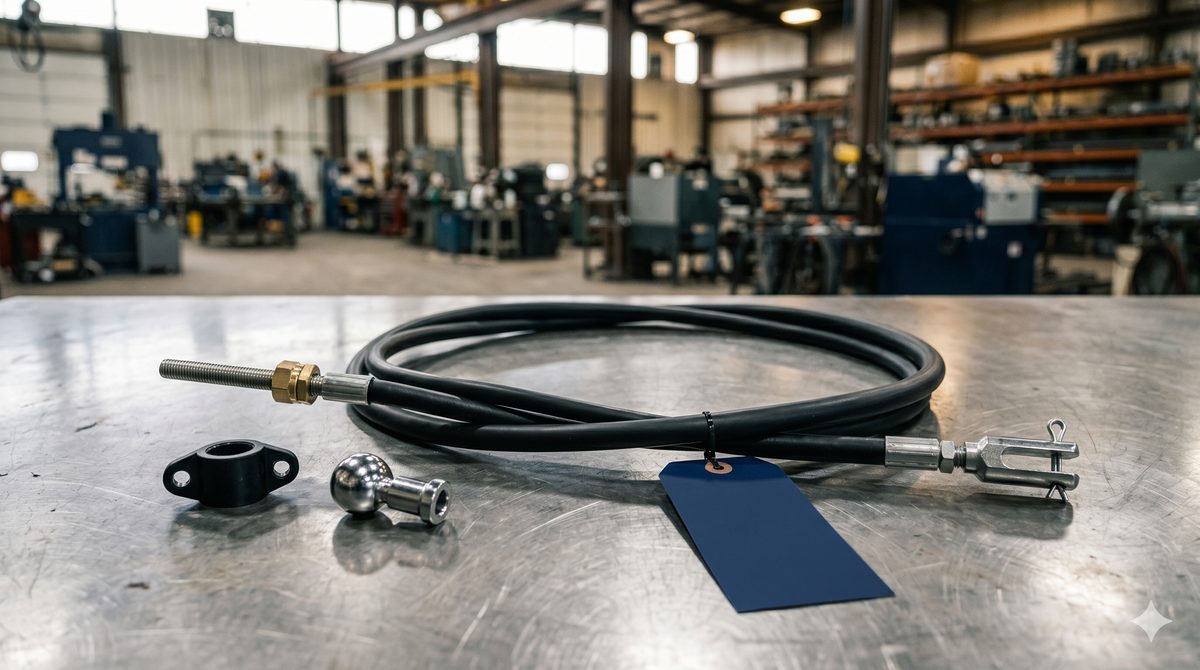
A control cable is five things working together: the core that carries the motion, the conduit that contains it, the jacket that protects the conduit, the end fittings on each side, and the mounting hardware that anchors the assembly to the equipment. Any one of those, built or selected wrong, can compromise the whole assembly. The point of a custom build is to get all five aligned to the actual application instead of accepting whatever a standard catalog cable gives you.
What we fabricate to your spec:
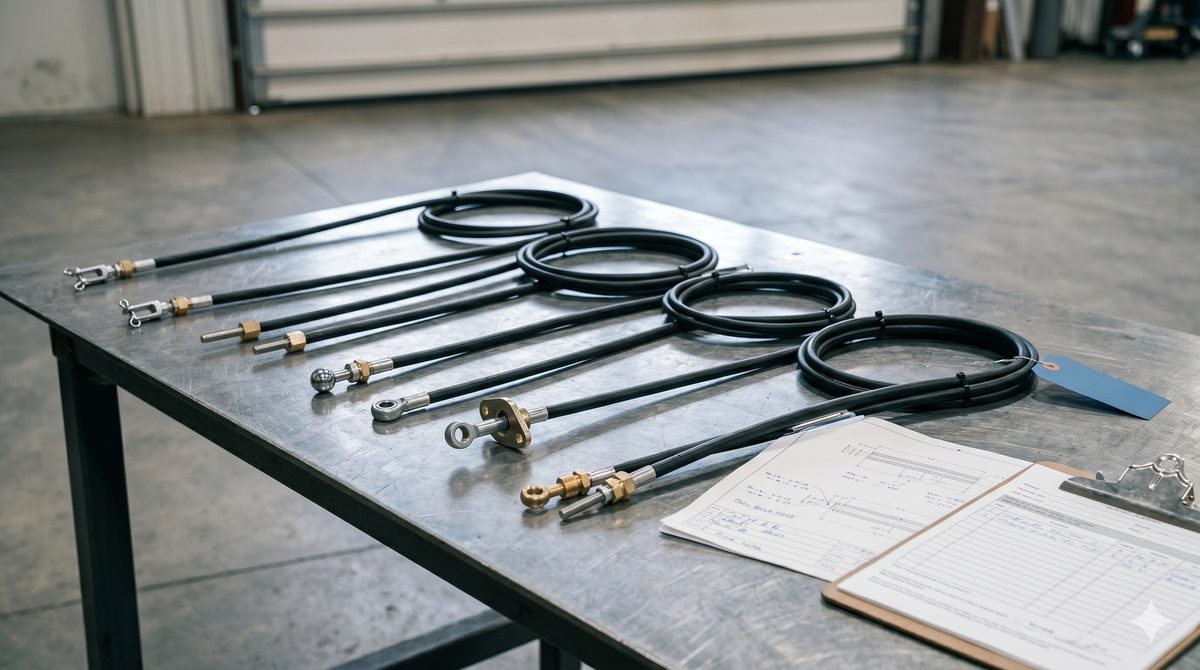
Reverse-Engineered from Your Sample
If the part number is obsolete or the cable came off a 30-year-old machine, our team works from a sample (or a sketch and measurements) to define a replacement built to the original envelope.
Checked for Action Before It Ships
Cut to your length, terminated with the ends the equipment actually requires, and checked for action before the assembly leaves the shop — so what you install is a cable engineered to the duty rather than adapted to it.
FAILURE PATTERNS WE DESIGN OUT
What Goes Wrong, and How a Proper Build Prevents It
In two decades of supporting mechanical control systems, the same handful of failure modes show up again and again. The point of going custom is not that custom is fancier. It is that custom removes the assumptions a generic cable forces you to live with.
Length compromises.
Too long and the cable bows and steals stroke. Too short and the routing fights the brackets. Built to your actual length, the assembly seats and strokes cleanly.
Bend radius violations.
Routing a cable tighter than its construction allows work-hardens the core and binds the action. Specifying around the available radius prevents the bind before it starts.
End mismatch.
Wrong thread, wrong clevis width, wrong stud diameter. The cable looks installed but the joint is loaded sideways and wears out a season early.
Wrong construction for the environment.
An indoor-rated jacket on a marine installation cracks at the first salt cycle. The right construction is a build decision, not a field fix.
Inconsistent fleet feel.
When every cable on a fleet was assembled differently, every operator runs the equipment differently. Repeatable builds give every unit the same response at the lever.
BUILT TO YOUR SPEC
Specifying a Cable Assembly That Fits the First Time
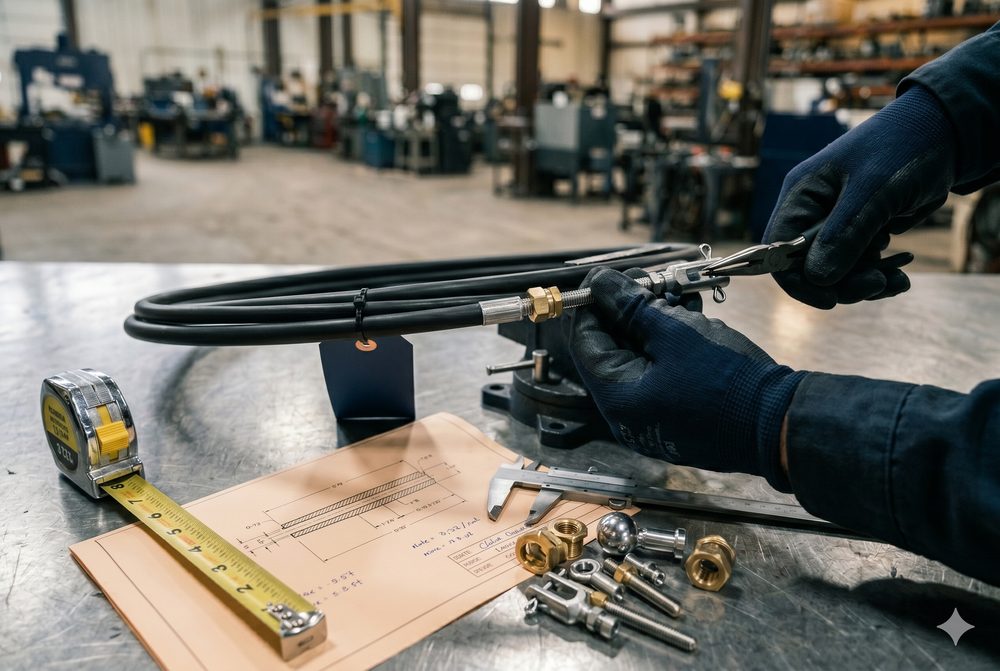
The fastest way to a finished cable is a short conversation up front about what the assembly actually has to do. Most builds need five or six pieces of information, and any of them you do not have, our team can help you pin down before we cut.
To scope a build we work from:
- Overall length and required stroke, plus any preload or free play the linkage calls for
- Cable construction and jacket, matched to the operating temperature, fluids, and weather the assembly will see
- End fittings on both ends, with the thread, clevis width, ball stud size, or eye dimensions the equipment requires
- Mounting and bulkhead hardware, so the cable anchors where it has to anchor
EQUIPMENT WE BUILD FOR
Equipment and Industries We Build For
The pattern that drives this work is consistent. Wherever an operator sits at a lever and an actuator does something at the other end of the machine, the cable in between decides how the equipment feels. The applications where that matters most:
Mobile & Heavy Equipment
For throttle, transmission, and brake controls that run all day in vibration and weather — built to the stroke, the routing, and the duty cycle the machine actually sees.
Marine Vessels
For throttle, shift, and remote valve actuation in environments where corrosion is constant — constructions and end hardware rated for marine, outdoor, and washdown service.
Industrial Machinery & Process Equipment
For remote valve operation when the operator station is not co-located with the hydraulic or pneumatic component.
Agricultural Equipment
For season-long duty under dust, vibration, and intermittent use — built for the conditions the equipment lives in.
Generator Sets & Engine-Driven Equipment
For throttle and shutdown controls run from a remote panel, where the cable carries the operator's command to the engine without compromise.
OEM & Fleet Programs
For repeatable cable assemblies built to one spec across many units, so every operator gets the same control feel from the first unit to the hundredth.
The goal is constant from one job to the next: a cable that disappears into the machine and lets the operator focus on the work, not on the lever.
Common Questions About Custom Control Cables
What kinds of control cables do you build?
Custom-length push-pull cable assemblies for throttle, transmission, clutch, parking brake, and remote valve actuation, across industrial, mobile, agricultural, and marine equipment. Share the application and we will confirm the right construction and end style.
My cable does not have a current part number. Can you still build a replacement?
Yes. Send us the original assembly, even if it is worn or damaged. We capture the overall length, stroke, end fittings, and mounting hardware from the sample and build a replacement to that same envelope.
Do you supply the end fittings and mounting hardware too?
Yes. End fittings (clevises, threaded studs, ball joints, eye ends) and mounting hardware (bulkhead nuts, jam nuts, support brackets) are part of the assembly, selected to fit the equipment the cable will land on.
How do I know what length and stroke to ask for?
If you have a drawing or a sample, we work from that. If you do not, our team will walk through the lever throw, the actuator travel, and the routing path with you and define the length, stroke, preload, and free play before anything is cut.
Are the cables built for marine and outdoor use?
Construction and jacket are chosen to the environment. For marine, outdoor, and washdown installations we use constructions rated for those conditions, including corrosion-resistant end hardware where appropriate.
Can the cables be built for fleet consistency?
Yes. For OEM and fleet programs we work to a documented spec so every assembly in a run is built the same way and every unit responds the same to the operator.
Can control cable work be combined with other HSC services?
Yes. Cable assemblies are regularly part of larger control packages that also include hydraulic hose, tube bending, cut and weld, and custom fabrication work, all coordinated under one team.
How do I start a control cable project?
Send your drawing or a sample cable, your length and stroke requirements, the equipment or end fittings the cable has to mate to, and your timeline. Our team will scope the build.
Start Your Control Cable Project
Send us your drawing or a sample cable, your length and stroke requirements, and your timeline.