

Brand
Aeroquip® by Danfoss
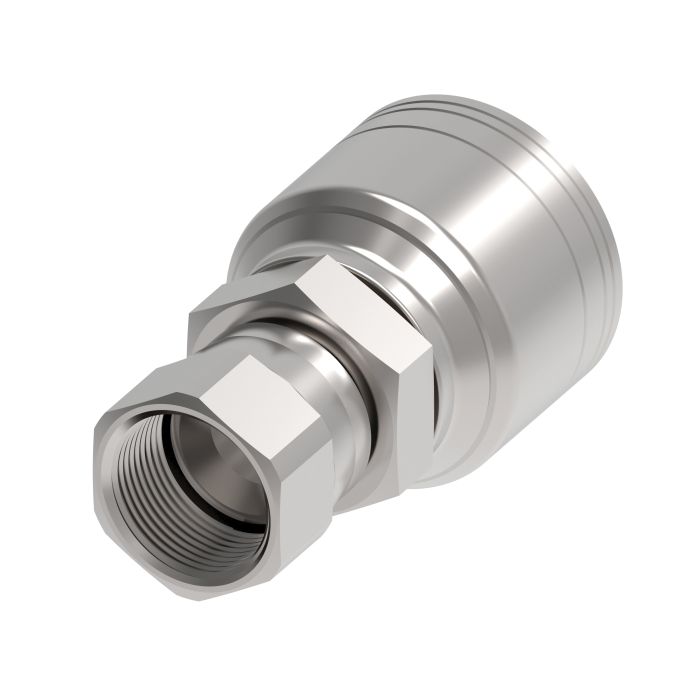
Engineered for demanding industrial environments the DANFOSS / EATON 316SS -20 FJIC Swivel ensures precise and secure connections. This component crafted by Danfoss Hydraulics (Luzhou) Co. Ltd is designed for durability and reliability.
Constructed from high-grade 316 stainless steel the swivel offers exceptional resistance to corrosion and wear making it ideal for rigorous applications across various sectors. Its FJIC swivel design facilitates flexible movement addressing dynamic requirements without compromising structural integrity.
Maintenance and downtime are simplified as this component allows for easy assembly and disassembly. It remains a preferred choice for professionals seeking dependable performance in complex systems.
Supplier Part Number: 1AV20FJ20C
MPN: 1AV20FJ20C
|
Brand
Aeroquip® by Danfoss
|
a Dimensions
3.44 in
|
Compatible Hose ID
1-1/4 in
|
Connection Size 1
1-1/4 in
|
Connection Size 2
1-1/4 in
|
Connection Type
Female JIC Swivel, Hose
|
Connection Type 1
Hose
|
Connection Type 2
Female 37 deg JIC Swivel
|
Construction Style
Crimp
|
Cut-Off Factor
1.88 in
|
Dimensions
3.61 in L x 2.41 in W x 2.41 in H
|
End Connection Torque
127 to 133 lb-ft
|
End Size 1
20
|
Fitting Type
Hose Fitting
|
Hex Size
2 in
|
Hose Dash Size
20
|
Inside Diameter
1.05 in
|
Material
Stainless Steel
|
Material Construction
316 Stainless Steel
|
Series
1A Series
|
Thread Size
1-5/8-12
|
Thread Type
UN
|
Tell us what you need and we'll get back to you.
Fields marked * are required.
Thanks — your inquiry's on its way