

Brand
Aeroquip® by Danfoss
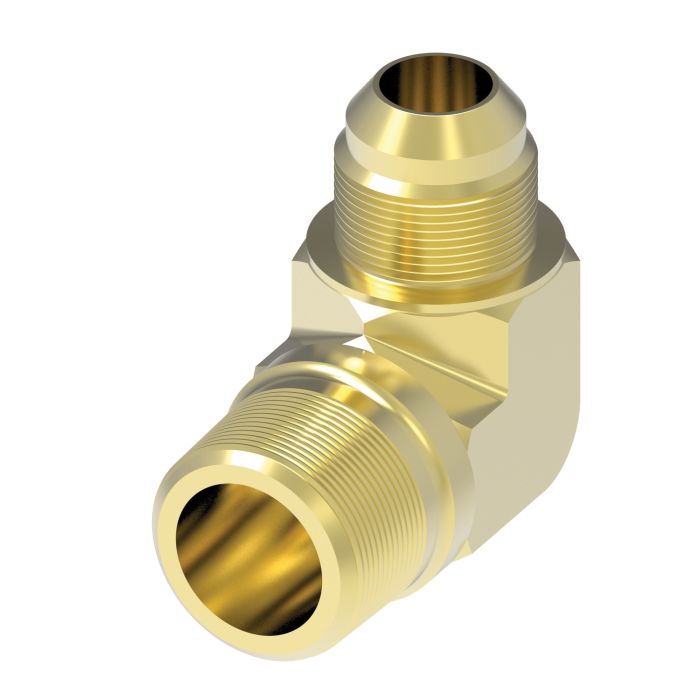
This 90-degree elbow is a brass adapter with a 1/4-18 Male NPT to 7/16-20 Male JIC 37 deg Flare connection. It is suitable for use in marine/military, chemical processing, pulp and paper industries, food and beverage processing, and off-shore drilling applications.
The fitting has a minimum working temperature of -65 degrees. This DANFOSS POWER SOLUTIONS (II LLC AEROQUIP) adapter, catalog number C1AW20, features a 0.25-inch tube O.D. and a 1.0500-inch drop dimension.
SKU: 2024-4-4B
Supplier Part Number (MPN): 2024-4-4B
Alternate Part Numbers: C1AW20, MI-00312880, MINO-00015F61730
|
Brand
Aeroquip® by Danfoss
|
a Dimensions
1.09 in
|
b Dimensions
1.05 in
|
Connection Size 1
1/4 in
|
Connection Size 2
1/4 in
|
Connection Type
Male JIC, MNPT
|
Connection Type 1
Male NPTF
|
Connection Type 2
Male 37 deg
|
Dimension Standards
SAE 070202
|
Drop Dimensions
1.05 in
|
Fitting Type
90 deg Elbow
|
Hex Size
0.55 in
|
Material
Brass
|
Material Construction
Brass
|
Operating Temperature
-65 to 250 deg F
|
Series
2024 Series
|
Thread Size
7/16-20, 1/4-18
|
Tube OD
1/4 in
|
| Model Number | Tube O.D. | Thread Size | Thread 2 | a Dimensions | b Dimensions | Price | Action |
|---|---|---|---|---|---|---|---|

2024-12-12B Brass Male NPT To JIC 90 Elbow |
0.75 |
1-1/16-12 |
1-1/16-12 |
1.59 in |
1.66 in |
|
|

2024-16-16B Brass Male NPT To JIC 90 Elbow |
1 |
1-5/16-12 x 1-11-1/2 x 1-5/16-12 |
1-5/16-12 |
1.97 in |
1.81 in |
|
|

2024-4-6B Brass Male NPT To JIC 90 Elbow |
0.38 |
9/16-18 |
9/16-18 |
1.09 in |
1.06 in |
|
|

2024-6-6B Brass Male NPT To JIC 90 Elbow |
0.38 |
9/16-18 |
9/16-18 |
1.22 in |
1.14 in |
|
|

2024-8-6B Brass Male NPT To JIC 90 Elbow |
0.38 |
9/16-18 |
9/16-18 |
1.47 in |
1.13 in |
|
|

2024-8-8B Brass Male NPT To JIC 90 Elbow |
0.5 |
3/4-16 |
3/4-16 |
1.47 in |
1.33 in |
|
Tell us what you need and we'll get back to you.
Fields marked * are required.
Thanks — your inquiry's on its way