
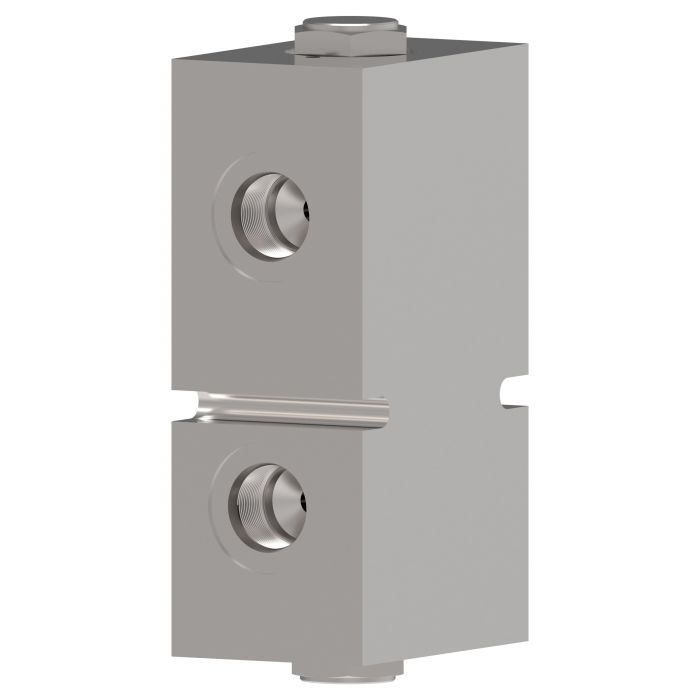
DPC1-10 Series Inline Double Pilot Operated Check Valve, Ports

Description & Features

Ideal for industry applications, the DPC1-10 Series Inline Double Pilot Operated Check Valve, Ports, from Danfoss Hydraulics, is designed with high operational efficiency and low spring settings. This model boasts a maximum operating pressure of 3000 PSI and a flow rating of 12 GPM, making it suitable for rigorous environments. The compact design features 3/8" port size and Buna-N seal material, ensuring durability and reliable performance. Known for its 4:1 pilot ratios, this valve is effective in locking a cylinder without leakage while the control valve is neutral. Its operational capacity includes managing temperatures from -40deg;F to 248deg;F, aligned with ISO 4406 cleanliness standards.

Model Number: DPC1-10-P-6T

Supplier Part Number: 566314

Specifications

Brand
Danfoss – Hydraulics
Brand
Danfoss Power Solutions
Pack Size
1.00
UOM
EA
Features
350 bar (5000 psi) & 227 L/min (60 USgpm)|High operational efficiency|Low spring settings
Port Size
3/8"
Alternate Part Numbers
Alternate Part Number C1BT61, Alternate Part Number DPC110P6T
Supplier Part Number
566314
Product Weight
1.54 lbs

Similar Products

Model Number Part Number Seal Material Price Action
DPC1-10 Series Inline Double Pilot Operated Check Valve,  Ports

DPC1-10-P-6T DPC1-10 Series PO Check Valve

566314

Buna-N

Product Questions & Answers (4)

Question by: Ronnie C on Jan 30, 2026, 10:31 AM
got a cylinder that creeps when the valve’s in neutral. is this the kind of check valve that’ll lock it up?
Answer by: Customer Support on Feb 1, 2026, 6:23 AM
In lock valve circuits, a pilot operated check valve is used to lock a cylinder without leakage while the control valve sits in neutral. It will allow flow to the cylinder, then block reverse flow until pilot pressure is applied to unlock the circuit, which helps keep a load from moving when the pressure source is inactive.
Question by: Patty H on Jan 13, 2026, 12:18 PM
got a cylinder on a log splitter that keeps drifting when the valve's in neutral -- would a double pilot operated check valve like this one actually stop that?
Answer by: Customer Support on Jan 14, 2026, 8:45 PM
Lock valves are built exactly for that situation. When your control valve sits in neutral, this valve blocks reverse flow from both sides of the cylinder with no leakage, so the cylinder holds its position. The key thing to know is that a 4-way control valve is required in the circuit, even on single acting setups, because the pilot circuit needs a path to apply unlocking pressure when you want the cylinder to move again. As long as your control valve has a free-flow motor spool, pressure won't build up between the lock valve and the control valve, which is a common problem people run into.
Question by: Ray A on Oct 18, 2025, 8:44 AM
what's the unlocking pressure calculation for a double acting cylinder with this valve? trying to figure out if our pilot circuit's got enough pressure to actually release the blind end
Answer by: Customer Support on Oct 19, 2025, 3:51 PM
For the blind end of a double acting cylinder, the formula works like this: take the blind end locked pressure and divide it by the quantity of 4.0 minus the rod end locked pressure divided by the ratio of net rod area to total cylinder area. More simply put, the rod area ratio is calculated as cylinder area minus rod area, all divided by cylinder area. The 4:1 pilot ratio built into this valve is what drives that math. For the rod end, the same structure applies but you swap the blind end and rod end values in the formula. Run your actual cylinder dimensions and locked pressures through both and you'll know exactly what your pilot circuit needs to deliver.
Question by: Danny M on Apr 7, 2025, 7:07 PM
trying to lock a double-acting cylinder in place when the 4-way valve is centered. will this one actually hold it without creeping?
Answer by: Customer Support on Apr 9, 2025, 2:13 PM
In a lock valve circuit, the DPC1-10 is meant to lock a cylinder without leakage while the control valve sits in neutral. It allows flow to the cylinder, then blocks reverse flow until pilot pressure is applied to unlock it, using a 4:1 pilot ratio.