
A
5.25
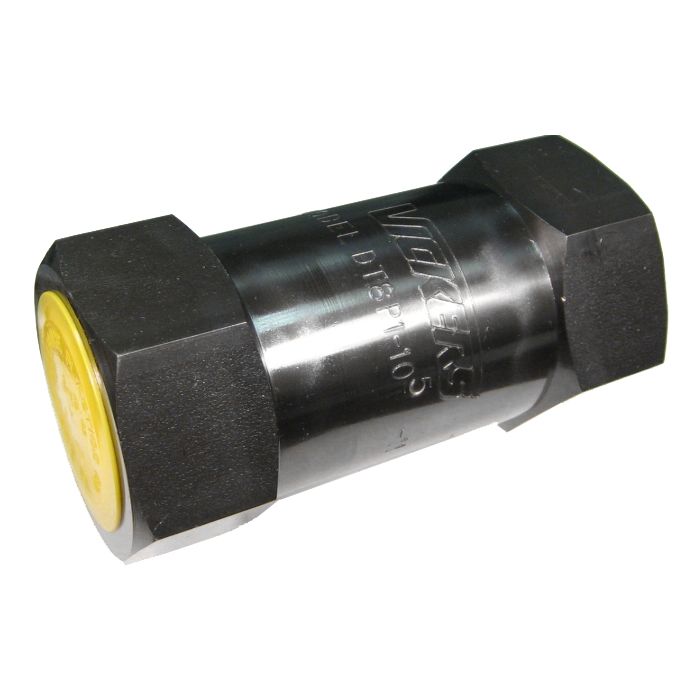
Featuring 1-1/4 NPT ports and a 5 PSI cracking pressure these check valves support a flow rate of up to 50.00 GPM. The stability under pressure and minimal maintenance requirements make them ideal for demanding environments such as die casting foundry marine and turbine control applications.
Designed without elastomer seals these valves provide standard leakage protection ensuring durability and efficient operation. Suitable for low shock service these check valves should not be used to counteract high-velocity reverse flows that result in shock conditions.
Model Number: DT8P1-10-5-11
Supplier Part Number: 125667
|
A
5.25
|
Application
Die casting & foundry, Machine tool, Marine/Offshore, Press, Primary metal, paper, Test equipment & simulation, Turbine control (wind, steam, water)
|
B
2.50
|
Cracking Pressure
5 Psi
|
Cracking Pressure (psi)
5
|
Brand
DANFOSS POWER SOLUTIONS II LLC (VICKERS)
|
Brand
Danfoss Power Solutions
|
Pack Size
1.00
|
UOM
EA
|
Features
Stability under pressure|Minimal maintenance|Stop leaks before they start
|
Leakage
Standard
|
Rated Flow
50
|
Rated Flow
50
|
Seal Material
Buna-N
|
Size
1-1/4
|
Special Features
None
|
Supplier Part Number
125667
|
Thread 1
1-1/4 NPT
|
Alternate Part Numbers
C1AJ58,
DT8P110511,
MINO-00900H14605
|
Product Weight
5.00 lbs
|
| Model Number | Part Number | Size | Thread 1 | Rated Flow | Cracking Pressure (psi) | A | B | Price | Action |
|---|---|---|---|---|---|---|---|---|---|

DT8P1-02-5-10 DS8P1 & DT8P1 Series Check Valve |
114088 |
1/4 |
1/4 NPT |
3.2 |
5 |
2.25 |
0.88 |
|
|

DT8P1-06-5-11 DS8P1 & DT8P1 Series Check Valve |
125670 |
3/4 |
3/4 NPT |
20 |
5 |
3.88 |
1.5 |
|
|

DT8P1-03-5-10 DS8P1 & DT8P1 Series Check Valve |
117378 |
3/8 |
3/8 NPT |
8 |
5 |
3 |
1 |
|
Tell us what you need and we'll get back to you.
Fields marked * are required.
Thanks — your inquiry's on its way