

Brand
ENERPAC®
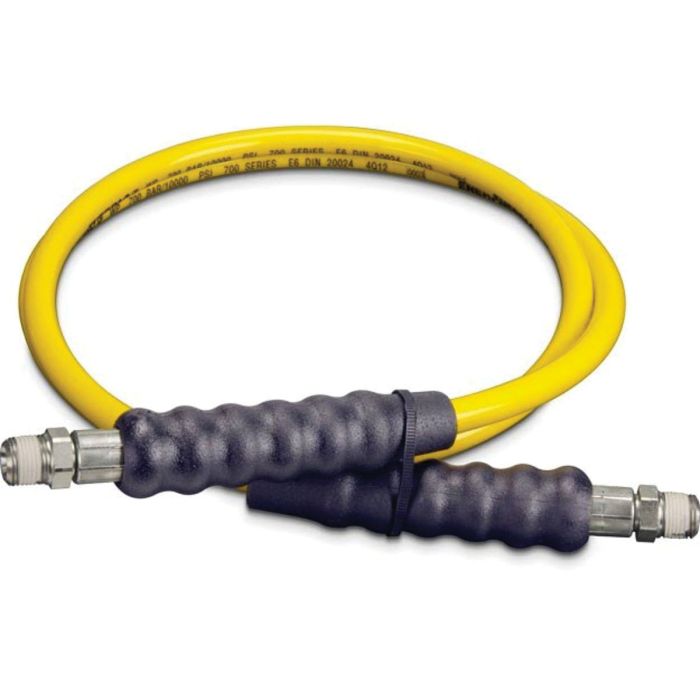
Engineered by Enerpac this 6 ft. Thermo-plastic High Pressure Hydraulic Hose .25 in. Internal Diameter offers exceptional durability and reliable functionality essential for demanding industrial applications.
Constructed with high-quality thermo-plastic material this hydraulic hose withstands high pressure conditions ensuring optimal performance and longevity. The .25 in. internal diameter guarantees efficient fluid transfer minimizing resistance and enhancing fluid flow. This hose is crafted to handle rigorous environments making it ideal for high force hydraulics systems.
Despite being constructed from robust materials the hose maintains flexibility allowing for easy installation and maneuverability in confined spaces. Designed for use in industrial settings it offers consistent and dependable performance under high pressure. Notably the hose does not include adjustable ends ensuring a secure and permanent fit once installed.
Supplier Part Number: H7206
Suitable for high force hydraulic systems this hose does not require a mandrel and is not machined mountable. It is also free of check valves providing a straightforward design focused on effective fluid transport. The hose is not color-coded diode-compatible nor does it include a switch connector further simplifying its use in various hydraulic applications.
|
Brand
ENERPAC®
|
Color
Yellow
|
Connection Type
NPT
|
Cover Material
Polyurethane
|
Dimensions
1/4 in ID x 6 ft L
|
Hose Color
Yellow
|
Hose Type
High-Pressure Hydraulic Hose
|
Inside Diameter
1/4 in
|
Material
Polyurethane/Thermoplastic
|
Nominal Size
3/8 in
|
Reinforcement
2-High-Tensile Braided Steel Wire
|
Series
H700 Series
|
Tube Material
Thermoplastic
|
Tell us what you need and we'll get back to you.
Fields marked * are required.
Thanks — your inquiry's on its way