

Brand
WEBTEC
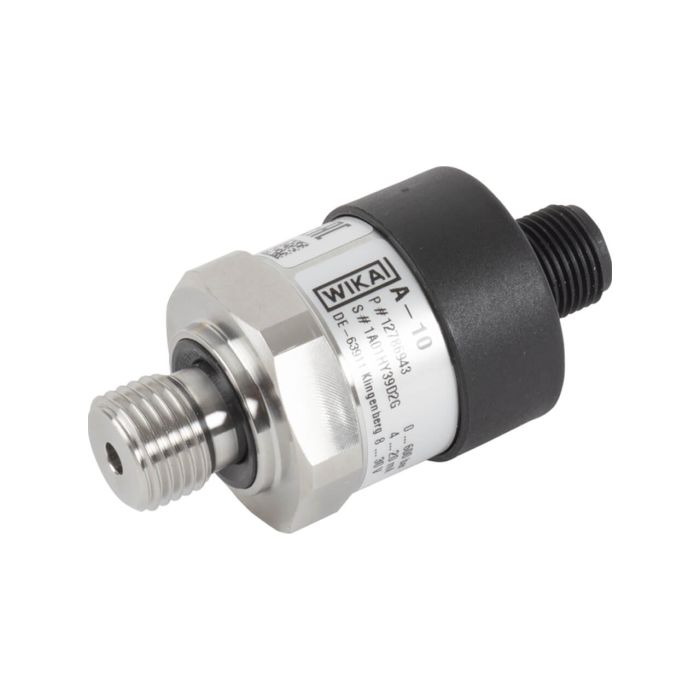
The WIKA A-10 series pressure transducer by WEBTEC is built for continuous oil pressure monitoring in hydraulic equipment, covering a measurement range up to 400 bar (5800 psi) with an accuracy of ±1% full scale. Output is delivered as a 4–20 mA signal over an M12 x 1, 4-pin connector, powered by an 8–30 V DC supply, making it straightforward to integrate with most data acquisition or control systems.
Constructed from 316L stainless steel with FKM seals, the transducer handles mineral oils to ISO 11158 and operates across a fluid and ambient temperature range of -40 to 100°C (-40 to 212°F). The 1/4" BSPP male port provides a compact, reliable hydraulic connection, while the IP67 rating ensures resilience in demanding industrial environments. Weighing just 0.1 kg, it suits both fixed installations and portable test rigs.
SKU: FT11319-400
Supplier Part Number (MPN): WIKA-A-10-400B 4-20MA
|
Brand
WEBTEC
|
Brand
Webtec
|
Pack Size
1.00
|
UOM
EA
|
Supplier Part Number
FT11319-400
|
Pressure Accuracy
≤ ±1% Full Scale
|
Ambient Temperature
-40 to 100 °C, -40 to 212 °F
|
Body Materials
Stainless Steel 316L, HNBR, PA
|
Compatible Fluid
Mineral oils to ISO 11158 (other fluids on request)
|
Connection Type
M12 x 1, 4-Pin
|
Fluid Temperature Range
-40 to 100°C, -40 to 212°F
|
Gross Weight
0.17 kg, 0.37 lbs
|
Internal Materials
Stainless steel 316L and PH steel
|
IP Rating
IP67
|
Max Rated Pressure
400 bar, 5800 psi
|
Net Weight
0.1 kg, 0.2 lbs
|
Porting
1/4” BSPP male
|
Power Supply
8 – 30 V DC
|
Seals
FKM
|
Product Weight
0.99 lbs
|
Tell us what you need and we'll get back to you.
Fields marked * are required.
Thanks — your inquiry's on its way