
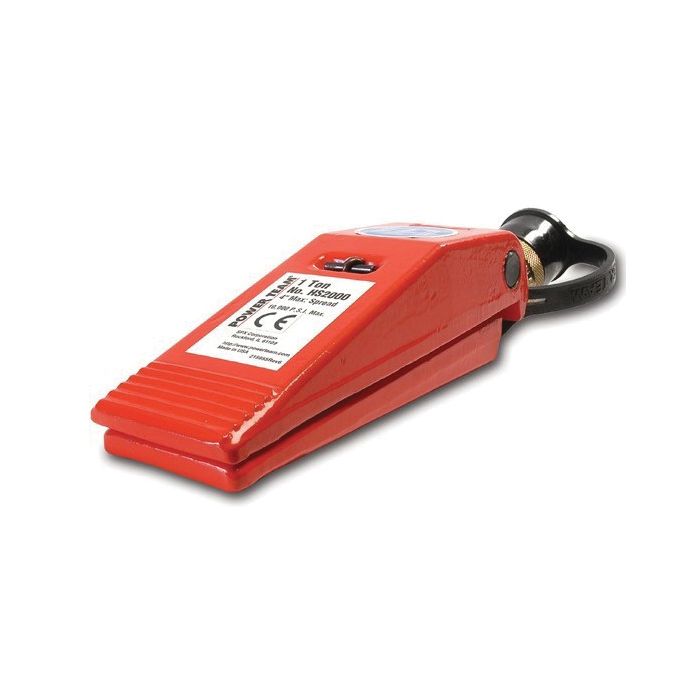

This hydraulic spreader from SPX Hydraulic Technologies delivers a 1-ton capacity at 10,000 psi, with a 4-inch maximum spread.
Featuring high-strength alloy steel forged upper and lower jaws, this hydraulic spreader requires only 0.56 inches of clearance to engage jaws. Use it to lift machines, as a clamp, or to spread concrete forms, rebar, and for straightening jobs. Jaws are spring-return and retract automatically when pressure is released. Conforms to ASME B30.1 standard.
SKU: HS2000
Supplier Part Number (MPN): HS2000
Alternate Part Numbers: C1KM23, MI-00838073, MINO-00630X05330
Loading related products…
Specifications
Capacity (tons)
1
Collapsed Tip Clearance
0.56
Brand
HYDRAULIC TECH USA LLC(SPX)
Brand
Hydraulic Tech USA
Pack Size
1.00
UOM
EA
Maximum Spread
4
Alternate Part Numbers
Alternate Part NumberC1KM23, Alternate Part Number MI-00838073, Alternate Part Number MINO-00630X05330
Supplier Part Number
HS2000
Product Weight
4.80 lbs
Similar Products
Model Number
Capacity (tons)
Collapsed Tip Clearance
Maximum Spread
Oil Capacity
Price
Action
HS2000Hydraulic Spreader
1
0.563
4
HS3000Hydraulic Spreader
1-1/2
1.25
11.5
Product Questions & Answers (3)
Question by: Dean H on Nov 26, 2025, 9:22 PM
What kinda clearance do I need to get this thing in place?
Answer by: Customer Support on Nov 28, 2025, 12:15 PM
You're gonna need just a hair over a half inch, about 0.56 inches to be exact, to get the jaws where they need to be.
Question by: Lance H on Feb 18, 2026, 8:33 AM
got a tight spot, how much gap do i need to get the jaws in there?
Answer by: Customer Support on Feb 20, 2026, 6:02 AM
With the jaws collapsed, it only needs about 0.56 inch of tip clearance to engage, which is roughly 9/16 inch.
Question by: Ross W on Jun 8, 2025, 3:53 PM
only got about half an inch of gap to work with on this press frame, will that be enough to get the jaws in there?
Answer by: Customer Support on Jun 10, 2025, 7:23 AM
Half an inch is right on the edge, but you should be fine. The HS2000 needs just 9/16 of an inch of clearance to engage the jaws, which works out to about 0.563 inches. If your gap is at least that wide, the tool will seat properly and you can get to work.