
-
All Products
- Hydraulic Power Systems & Components
- Shop all
- Hydraulic Pumps & Accessories
- Hydraulic Motors & Accessories
- Hydrostatic Transmissions
- Cylinders & Accessories
- Steering Units & Accessories
- Hydraulic Valves & Accessories
- Shop all
- Ball Valves
- Check Valves
- Check Valves (Pilot-Operated)
- Counterbalance Valves (Overcenter Valves)
- Cushion Valves (Double Relief Valves)
- Directional Control Valves
- Flow Control Valves
- Flow Divider Valves
- Gate Valves
- Logic Element Valves
- Needle Valves
- Plug Valves
- Pressure Reducing Valves
- Relief Valves
- Sandwich Valves
- Premium Selector Valves
- Slip-In Cartridge Valves
- Premium Stack Valves
- System Accessory Valves
- Premium Truck Valves
- Valve Accessories
- Electronic Control Components
- Pressure Sequence Valves
- Screw-In Cartridge Valves
- Motion Control Valves
- Shop Logic Element Valves
- Unloading Valves
- Drain Valves
- Hydraulic Filters & Accessories
- Power Units
- System Accessories
- High Force Hydraulics
- Pneumatic Power & Control
- Shop all
- Pneumatic Cylinders
- Pneumatic Valves & Accessories
- Pneumatic Air Line Filter, Regulator, & Lubicator (FRL's)
- Pneumatic Air Line Filters
- Premium Air Tool Hose Assemblies
- Air Line Lubricating Oil
- Safety Pop-Off Valves
- Pneumatic Air Line Filter & Regulator
- Pneumatic Air Line Filter Accessories
- Pneumatic Air Line Lubricators
- Pneumatic Air Tools
- Pneumatic Air Line Filter, Regulator, & Lubricator (FRL's)
- Pneumatic Air Line Regulators
- Pneumatic Cylinder Accessories
- Fluid Conveying
- Shop all
- Hose Products
- Tubing Products
- Piping Products
- Adapters
- Shop all
- Steel
- Shop all
- O-Ring Face Seal Braze Adapters
- O-Ring Face Seal To Straight Thread O-Ring
- O-Ring Face Seal To Pipe
- O-Ring Face Seal To 37° Flare
- O-Ring Face Seal To O-Ring Face Seal
- O-Ring Face Seal Accessories
- Pipe To Pipe
- Pipe to 37° Flare
- Pipe To Straight Thread O-Ring
- Pipe To Hose
- 37° Flare Union
- Straight Thread O-Ring to 37° Flare
- Straight Thread O-Ring to Straight Thread O-Ring
- Straight Thread O-Ring to Hose
- SAE Split Flange To 37° Flare
- SAE Split Flange To O-Ring Face Seal
- Braze & Weld to 37° Flare
- 42° Inverted Flare to 37° Flare
- Restrictor
- Metric to 37° Flare
- Metric to Pipe
- Metric
- BSPP to 37° Flare
- BSPP to Pipe
- BSPP to Metric
- BSPP to BSPT
- BSPP
- BSPT To Pipe
- BSPT To 37° Flare
- JIS
- JIS 30° Seat (BSPP Thread) To 37° Flare
- Komatsu, Kobelco
- BSPP to 37 deg Flare
- BSPT To JIS
- 37 deg Flare Union
- Pipe to 37 deg Flare
- Straight Thread O-Ring to 37 deg Flare
- O-Ring Face Seal To BSPP
- SAE Split Flange To 37 deg Flare
- Straight Thread O-Ring to Metric
- Metric to 37 deg Flare
- Straight Thread O-Ring to Pipe
- 37 deg Flare Plug
- BSPT To 37 deg Flare
- JIS 30 deg Seat (BSPP Thread) To 37 deg Flare
- O-Ring Face Seal To JIS
- Straight Thread O-Ring to BSPP
- O-Ring Face Seal To Metric
- SAE Split Flange To Pipe
- Auxiliary Components
- O-Ring Face Seal To 37 deg Flare
- Straight Thread O-Ring to JIS
- Braze & Weld to 37 deg Flare
- Metric to BSPT
- Pipe To STC (Snap to Connect)
- BSPP To Hose
- Flareless Fittings
- Braze & Weld to Pipe
- SAE Split Flange To SAE Split Flange
- SAE Split Flange To Straight Thread O-Ring
- 42 deg Inverted Flare Union & Accessories
- Push-to-Connect To STC (Snap to Connect)
- O-Ring Face Seal To STC (Snap to Connect)
- BSPT
- Pipe To 30 deg Flare
- SAE Split Flange Braze Adapters
- BSPT To Hose
- 42 deg Inverted Flare to 37 deg Flare
- Push-On to 37 deg Flare
- O-Ring Face Seal To Hose
- Stainless Steel
- Shop all
- Pipe To Pipe
- Pipe To 37° Flare
- 37° Flare Union
- Straight Thread O-Ring To 37° Flare
- Metric To 37° Flare
- BSPP To 37° Flare
- Auxiliary Components
- Metric
- BSPP
- 37 deg Flare Union
- BSPP To Pipe
- Straight Thread O-Ring To Pipe
- Pipe To 37 deg Flare
- BSPP To 37 deg Flare
- Metric To Pipe
- Metric To 37 deg Flare
- BSPP To Metric
- O-Ring Face Seal To Pipe
- Straight Thread O-Ring To 37 deg Flare
- BSPT To 37 deg Flare
- O-Ring Face Seal To Straight Thread O-Ring
- Straight Thread O-Ring To Straight Thread O-Ring
- SAE Split Flange To 37 deg Flare
- Pipe To Hose
- 37 deg Flare To Hose
- O-Ring Face Seal To O-Ring Face Seal
- 37 deg Flare Plug
- Straight Thread O-Ring To BSPP
- Braze & Weld to Pipe
- Metric to BSPT
- BSPT To Pipe
- BSPT
- Brass
- Shop all
- Pipe To Pipe
- Pipe To 37° Flare
- Pipe To 45° Flare
- 45° Flare Union
- 42° Inverted Flare To 45° Flare
- 42° Inverted Flare To Pipe
- 42° Inverted Flare Unions & Accessories
- Garden Hose Adapters
- Pipe To 45 deg Flare
- Braze & Weld to Pipe
- 42 deg Inverted Flare To Pipe
- 45 deg Flare Union
- BSPP
- 45 deg Inverted Flare Union
- Pipe To 37 deg Flare
- 37 deg Flare Union
- Pipe To Hose
- BSPP To Pipe
- 37 deg Flare To Hose
- BSPT To Hose
- 42 deg Inverted Flare To 37 deg Flare
- 45 deg Flare To Hose
- 45 deg Inverted Flare To Pipe
- BSPT
- 45 deg Inverted Flare To Hose
- BSPP to BSPT
- 37 deg Flare Plug
- 45 deg Inverted Flare To Tube
- O-Ring Face Seal Braze Adapters
- BSPP To Hose
- BSPT To Pipe
- Metric to Flare
- BSPT To 45 deg Flare
- Metric
- Metric To Pipe
- Stainless Steel Steel
- Hydraulic Quick Disconnects
- Miscellaneous Fluid Conveying Parts
- Shop all
- Flanges
- Metric & BSP Seals & Washers
- Protective Closures
- Split Flange Kits & O-Rings
- Support Clamps
- Swivel Joints
- Air Brake Products
- Hose, Tube & Pipe Cleaning System
- Flange Accessories
- Hose, Tube & Pipe Cleaning System Accessories
- Brake Hose Accessories
- Hose Accessories
- Support Clamp Accessories
- Fitting Assortments
- Performance Parts
- Shop all
- Hose
- Adapters
- Brake System Adapters
- Fuel System Components
- Couplings
- PRO CLAMP and Overbraid
- Accessories
- Reusable Fittings for AQP & Starlite Racing Hose
- Crimp Fittings for AQP & Starlite Racing Hose
- Fittings for AQP Socketless Hose
- Reusable Fittings for Aeroquip FBF A/C Hose
- Fittings for Teflon Racing Hose
- Reusable Fittings for AQP High Pressure Hose
- Assembly Equipment
- Hydraulic Brake Components
- Other Products
- Shop all
- Hydraulic Fluids & Oils for Industrial Systems
- Seals
- Industrial Chemical Maintenance Products
- Lubrication Equipment & Accessories
- Fasteners
- Valves
- Couplings
- Bearings
- Control Cables
- Thread Sealants
- Gloves
- Hand Tools
- Pressure Washer Products for Industrial & Commercial Use
- Hose Reels
- Winches
- Cable Hardware & Knobs
- Cable Remote Controls
- Industrial Corrosion Inhibitors
- Y Strainer
- Hose Nozzles
- Textbooks
- Cable (Wire) Ties
- Piston Vibrators
- Software Licenses
- Human Machine Interface & Accessories
- Safety Glasses
- Hydraulic Punches & Dies
- Thread Sealant Tapes
- Identification Tools
- Gasket Makers
- Threadlockers
- Tool Storage
- Temperature Controllers & Accessories
- Brazing Rods
- Gear Drives & Accessories
- Gauges
- Drill Bits
- Paint Markers
- Switches & Accessories
- Power Tools
- Cut-Off Wheels
- Work Lights
- Cleaning Cloths & Towels
- Hose Reel Accessories
- Labels
- Flashlights
- Shirts
- Pipe Wrapping Tapes
- Batteries
- Winch Parts & Accessories
- Pen Lights
- Hydraulic Power Systems & Components
-
Services
- 24/7 On-Site Mobile Services
- Control Cable Assemblies
- Crimper Maintenance Program
- Custom Hydraulic Components Fabrication
- Cut & Weld
- Danfoss x20 Stock Change Program
- Engineering Center Services
- Hose Kitting Services
- HPU Build Program
- Hydraulic & Industrial Hose Assemblies
- Hydraulic Repair & Service
- Tube Bending Services
- Vane Pump Build Program
- View All Services
- Branch Locations
- Catalogs
- Help
- Quick Order
SAME DAY SHIPPING
— Order by 2pm EST.
Hydraulic Pump Replacement: Warning Signs and Key Considerations
Published May 21, 2026 | Last Updated July 13, 2026

A hydraulic pump is the heart of any fluid power system. When it starts to fail, the rest of the equipment follows. Cycle times slow down, pressure becomes inconsistent, and the machine your operation depends on stops performing the way it should. Knowing what to watch for and what to do about it can mean the difference between a quick repair and an extended, costly shutdown.
This guide covers the warning signs that indicate a pump may need attention, how to decide between repair and replacement, and what information you need to source the correct replacement pump from the start.
Warning Signs Your Hydraulic Pump May Need Replacement
Hydraulic pump failures do not always announce themselves ahead of time. Some failures develop gradually, giving operators and technicians a window to catch problems early, but others happen suddenly with little to no warning. A contamination event or a seal that gives out can take a pump out of commission without much lead time. When warning signs do appear, knowing which ones point to the pump specifically, rather than another component in the system, helps you move quickly in the right direction.
Unusual Noise During Operation
Unusual sounds are often the first sign that something has changed inside the pump. Cavitation and aeration are two of the more common culprits, and both produce noises that range from a high-pitched whine to erratic pressure fluctuations as air enters or mixes into the fluid. A mechanical knock tends to point further inward, toward worn gears, pistons, or vane assemblies. Regardless of the specific sound, any noise that is new or getting worse is worth investigating promptly rather than monitoring indefinitely.
Loss of System Pressure or Flow
When a hydraulic system begins struggling to reach or hold its operating pressure, the pump is a likely culprit. Worn internal components allow fluid to bypass rather than build pressure efficiently, which reduces the force available to actuators downstream. Flow loss shows up as slower cycle times, reduced lifting capacity, or equipment that cannot complete its full range of motion. A gradual decline is often tied to internal wear, while a sudden drop can indicate a more acute failure like a cracked housing or broken shaft component.
Excessive Heat
A pump that is wearing internally converts more energy into heat than it should, and that extra heat works its way through the entire system. Fluid temperature that runs consistently above normal operating ranges is worth taking seriously, since overheating accelerates seal degradation, thins the fluid, and compounds wear on every component the fluid contacts. Before assuming the pump is the source, it is worth ruling out other causes, such as a failing heat exchanger or incorrect fluid viscosity. If those check out, the pump itself warrants a closer look.
Visible Fluid Leaks
External leaks around the pump housing, shaft seal, or port connections indicate that the sealing system has been compromised. Shaft seal leaks are particularly common as pumps age and are often repairable. Leaks from the housing itself are a more serious sign, as they can indicate cracking or structural damage that may require full replacement. Fluid loss also creates secondary risks, including contamination of surrounding components and a drop in system fluid level that can accelerate pump wear further.
Slow or Erratic Actuator Movement
When cylinders hesitate, move inconsistently, or fail to reach full extension under normal loads, the pump may not be delivering adequate flow. This warning sign can overlap with valve or cylinder issues, so a systematic diagnosis is worth conducting before assuming the pump is the source. With that in mind, if other components check out and the pump shows signs of wear or age, it should be treated as a primary suspect.
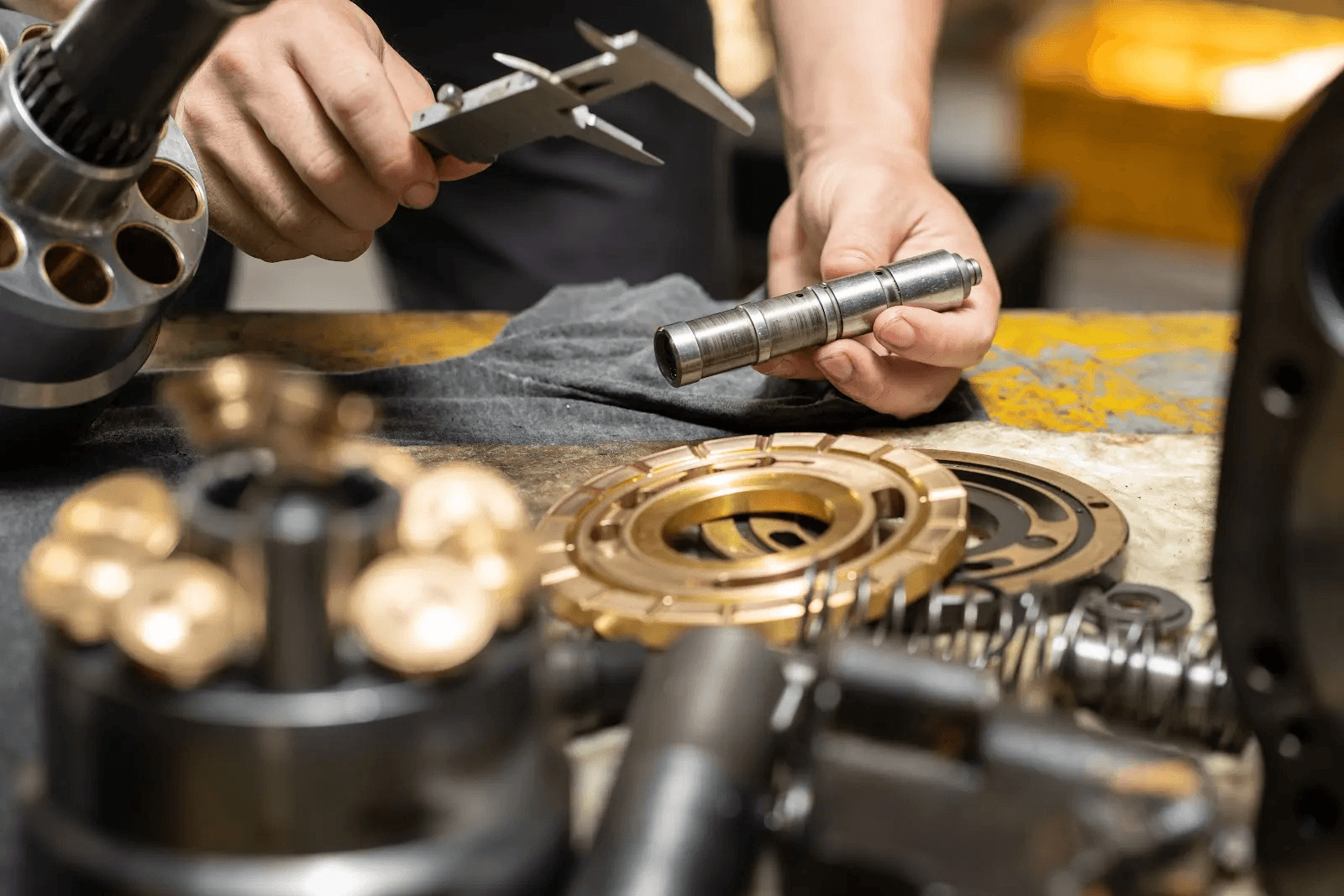
Repair vs. Replacement: How to Decide
Not every pump problem requires a full replacement, and the right call is not always obvious. The decision comes down to what has actually failed, how far the damage has progressed, and the overall condition of the pump.
When Repair Makes Sense
Repair is often a reasonable option when the failure is limited to seals, minor wear components, or contamination-related issues that have not caused broader internal damage. Seal kits are available for most common pump models, and in many cases, a rebuild can restore full performance at a fraction of the cost of a new pump, provided the core components are still within acceptable tolerances. A pump that has been in heavy service for many years may be approaching the end of its useful life regardless of the specific failure mode, making replacement the more economical long-term choice.
When it’s Time for a Hydraulic Pump Replacement
Replacement becomes the stronger option when the pump has suffered structural damage such as scored bores, worn gear sets, cracked housings, or shaft damage. These issues go beyond what a seal kit addresses, and rebuilding around compromised core components rarely delivers lasting results.
Repeated failures are also a signal worth taking seriously. If a pump has been repaired multiple times and continues to cause problems, the cost and downtime associated with another repair may exceed what a new pump would cost over the same period. In high-cycle applications where unplanned downtime carries a significant cost, replacement often makes more sense even when repair is technically possible. When replacement is the right call, understanding what to know before replacing a hydraulic cylinder can help you source the correct unit with confidence.
Cost Considerations
Cost plays a real role in deciding whether to repair or replace your part, and it goes beyond the price of parts.
A seal kit or minor rebuild is typically less expensive upfront than a new pump, but that calculation changes when you factor in labor, the risk of repeated failure, and the cost of downtime while the equipment is out of service. For operations where a hydraulic pump failure halts production or fieldwork, the cost of being down often exceeds the cost of the pump itself. In those situations, investing in a quality replacement from the start tends to be the more cost-effective decision over time.
Pump costs also vary considerably depending on type and application. Gear pumps used in mobile equipment sit at the lower end of the price range, while variable-displacement piston pumps used in more demanding systems carry a higher price point. Getting the right pump the first time, rather than settling for a near-match, is what keeps both repair and replacement costs from compounding down the line.
Finding the Right Hydraulic Pump Replacement with HSC
Identifying the warning signs early, knowing whether repair or replacement makes more sense for your situation, and understanding what the job is going to cost are all part of making a smart decision when a pump goes down. Getting those details right before you order is what prevents a straightforward replacement from turning into a drawn-out sourcing problem.
Hydraulic Supply Company carries a wide selection of hydraulic pumps across construction, agriculture, manufacturing, transportation, and more. Our team can help you identify the correct replacement and get your equipment back in service. Browse our hydraulic pump inventory to find your replacement, or contact us to schedule service or get support from our team.
FAQs
How do I know if my hydraulic pump is failing?
Common warning signs include unusual noises such as whining or knocking, loss of system pressure or flow, slow or inconsistent actuator movement, excessive fluid temperature, and visible leaks around the pump housing or shaft seal. Any combination of these warning signs warrants a thorough inspection before a complete failure occurs.
What causes hydraulic pump failure?
Hydraulic pump failure is most often caused by fluid contamination, cavitation, aeration, overheating, seal degradation, or operating beyond rated pressure. Infrequent fluid changes and neglected filtration are among the most common contributing factors in premature pump wear.
Should I repair or replace my hydraulic pump?
Repair makes sense when the failure is limited to seals or minor wear components and the pump's core structure is still sound. Replacement is typically the better choice when internal components are scored or damaged, the pump has failed repeatedly, or the pump has reached the end of its service life for the application.
What information do I need to order a hydraulic pump replacement?
You will need to confirm the pump type, displacement, pressure rating, shaft size and configuration, rotation direction, port size and thread type, and mounting flange dimensions. Having this information before you order significantly reduces the risk of receiving an incompatible unit.
Can I replace a hydraulic pump with a different brand?
In many cases, yes. As long as the replacement pump matches the original specifications for displacement, pressure rating, shaft and port configuration, and mounting dimensions, a pump from a different manufacturer can serve as a reliable replacement. Working with an experienced supplier to cross-reference specifications helps ensure compatibility.

Share on Facebook

Share on X

Share on Pinterest
Quick Add Product
Account Summary
Short Code:
Credit Limit:
Current Balance:
Recent Posts


Tell us what you need and we'll get back to you.
Fields marked * are required.
Thanks — your inquiry's on its way