
-
All Products
- Hydraulic Power Systems & Components
- Shop all
- Hydraulic Pumps & Accessories
- Hydraulic Motors & Accessories
- Hydrostatic Transmissions
- Cylinders & Accessories
- Steering Units & Accessories
- Hydraulic Valves & Accessories
- Shop all
- Ball Valves
- Check Valves
- Check Valves (Pilot-Operated)
- Counterbalance Valves (Overcenter Valves)
- Cushion Valves (Double Relief Valves)
- Directional Control Valves
- Flow Control Valves
- Flow Divider Valves
- Gate Valves
- Logic Element Valves
- Needle Valves
- Plug Valves
- Pressure Reducing Valves
- Relief Valves
- Sandwich Valves
- Premium Selector Valves
- Slip-In Cartridge Valves
- Premium Stack Valves
- System Accessory Valves
- Premium Truck Valves
- Valve Accessories
- Electronic Control Components
- Pressure Sequence Valves
- Screw-In Cartridge Valves
- Motion Control Valves
- Shop Logic Element Valves
- Unloading Valves
- Drain Valves
- Hydraulic Filters & Accessories
- Power Units
- System Accessories
- High Force Hydraulics
- Pneumatic Power & Control
- Shop all
- Pneumatic Cylinders
- Pneumatic Valves & Accessories
- Pneumatic Air Line Filter, Regulator, & Lubicator (FRL's)
- Pneumatic Air Line Filters
- Premium Air Tool Hose Assemblies
- Air Line Lubricating Oil
- Safety Pop-Off Valves
- Pneumatic Air Line Filter & Regulator
- Pneumatic Air Line Filter Accessories
- Pneumatic Air Line Lubricators
- Pneumatic Air Tools
- Pneumatic Air Line Filter, Regulator, & Lubricator (FRL's)
- Pneumatic Air Line Regulators
- Pneumatic Cylinder Accessories
- Fluid Conveying
- Shop all
- Hose Products
- Tubing Products
- Piping Products
- Adapters
- Shop all
- Steel
- Shop all
- O-Ring Face Seal Braze Adapters
- O-Ring Face Seal To Straight Thread O-Ring
- O-Ring Face Seal To Pipe
- O-Ring Face Seal To 37° Flare
- O-Ring Face Seal To O-Ring Face Seal
- O-Ring Face Seal Accessories
- Pipe To Pipe
- Pipe to 37° Flare
- Pipe To Straight Thread O-Ring
- Pipe To Hose
- 37° Flare Union
- Straight Thread O-Ring to 37° Flare
- Straight Thread O-Ring to Straight Thread O-Ring
- Straight Thread O-Ring to Hose
- SAE Split Flange To 37° Flare
- SAE Split Flange To O-Ring Face Seal
- Braze & Weld to 37° Flare
- 42° Inverted Flare to 37° Flare
- Restrictor
- Metric to 37° Flare
- Metric to Pipe
- Metric
- BSPP to 37° Flare
- BSPP to Pipe
- BSPP to Metric
- BSPP to BSPT
- BSPP
- BSPT To Pipe
- BSPT To 37° Flare
- JIS
- JIS 30° Seat (BSPP Thread) To 37° Flare
- Komatsu, Kobelco
- BSPP to 37 deg Flare
- BSPT To JIS
- 37 deg Flare Union
- Pipe to 37 deg Flare
- Straight Thread O-Ring to 37 deg Flare
- O-Ring Face Seal To BSPP
- SAE Split Flange To 37 deg Flare
- Straight Thread O-Ring to Metric
- Metric to 37 deg Flare
- Straight Thread O-Ring to Pipe
- 37 deg Flare Plug
- BSPT To 37 deg Flare
- JIS 30 deg Seat (BSPP Thread) To 37 deg Flare
- O-Ring Face Seal To JIS
- Straight Thread O-Ring to BSPP
- O-Ring Face Seal To Metric
- SAE Split Flange To Pipe
- Auxiliary Components
- O-Ring Face Seal To 37 deg Flare
- Straight Thread O-Ring to JIS
- Braze & Weld to 37 deg Flare
- Metric to BSPT
- Pipe To STC (Snap to Connect)
- BSPP To Hose
- Flareless Fittings
- Braze & Weld to Pipe
- SAE Split Flange To SAE Split Flange
- SAE Split Flange To Straight Thread O-Ring
- 42 deg Inverted Flare Union & Accessories
- Push-to-Connect To STC (Snap to Connect)
- O-Ring Face Seal To STC (Snap to Connect)
- BSPT
- Pipe To 30 deg Flare
- SAE Split Flange Braze Adapters
- BSPT To Hose
- 42 deg Inverted Flare to 37 deg Flare
- Push-On to 37 deg Flare
- O-Ring Face Seal To Hose
- Stainless Steel
- Shop all
- Pipe To Pipe
- Pipe To 37° Flare
- 37° Flare Union
- Straight Thread O-Ring To 37° Flare
- Metric To 37° Flare
- BSPP To 37° Flare
- Auxiliary Components
- Metric
- BSPP
- 37 deg Flare Union
- BSPP To Pipe
- Straight Thread O-Ring To Pipe
- Pipe To 37 deg Flare
- BSPP To 37 deg Flare
- Metric To Pipe
- Metric To 37 deg Flare
- BSPP To Metric
- O-Ring Face Seal To Pipe
- Straight Thread O-Ring To 37 deg Flare
- BSPT To 37 deg Flare
- O-Ring Face Seal To Straight Thread O-Ring
- Straight Thread O-Ring To Straight Thread O-Ring
- SAE Split Flange To 37 deg Flare
- Pipe To Hose
- 37 deg Flare To Hose
- O-Ring Face Seal To O-Ring Face Seal
- 37 deg Flare Plug
- Straight Thread O-Ring To BSPP
- Braze & Weld to Pipe
- Metric to BSPT
- BSPT To Pipe
- BSPT
- Brass
- Shop all
- Pipe To Pipe
- Pipe To 37° Flare
- Pipe To 45° Flare
- 45° Flare Union
- 42° Inverted Flare To 45° Flare
- 42° Inverted Flare To Pipe
- 42° Inverted Flare Unions & Accessories
- Garden Hose Adapters
- Pipe To 45 deg Flare
- Braze & Weld to Pipe
- 42 deg Inverted Flare To Pipe
- 45 deg Flare Union
- BSPP
- 45 deg Inverted Flare Union
- Pipe To 37 deg Flare
- 37 deg Flare Union
- Pipe To Hose
- BSPP To Pipe
- 37 deg Flare To Hose
- BSPT To Hose
- 42 deg Inverted Flare To 37 deg Flare
- 45 deg Flare To Hose
- 45 deg Inverted Flare To Pipe
- BSPT
- 45 deg Inverted Flare To Hose
- BSPP to BSPT
- 37 deg Flare Plug
- 45 deg Inverted Flare To Tube
- O-Ring Face Seal Braze Adapters
- BSPP To Hose
- BSPT To Pipe
- Metric to Flare
- BSPT To 45 deg Flare
- Metric
- Metric To Pipe
- Stainless Steel Steel
- Hydraulic Quick Disconnects
- Miscellaneous Fluid Conveying Parts
- Shop all
- Flanges
- Metric & BSP Seals & Washers
- Protective Closures
- Split Flange Kits & O-Rings
- Support Clamps
- Swivel Joints
- Air Brake Products
- Hose, Tube & Pipe Cleaning System
- Flange Accessories
- Hose, Tube & Pipe Cleaning System Accessories
- Brake Hose Accessories
- Hose Accessories
- Support Clamp Accessories
- Fitting Assortments
- Performance Parts
- Shop all
- Hose
- Adapters
- Brake System Adapters
- Fuel System Components
- Couplings
- PRO CLAMP and Overbraid
- Accessories
- Reusable Fittings for AQP & Starlite Racing Hose
- Crimp Fittings for AQP & Starlite Racing Hose
- Fittings for AQP Socketless Hose
- Reusable Fittings for Aeroquip FBF A/C Hose
- Fittings for Teflon Racing Hose
- Reusable Fittings for AQP High Pressure Hose
- Assembly Equipment
- Hydraulic Brake Components
- Other Products
- Shop all
- Hydraulic Fluids & Oils for Industrial Systems
- Seals
- Industrial Chemical Maintenance Products
- Lubrication Equipment & Accessories
- Fasteners
- Valves
- Couplings
- Bearings
- Control Cables
- Thread Sealants
- Gloves
- Hand Tools
- Pressure Washer Products for Industrial & Commercial Use
- Hose Reels
- Winches
- Cable Hardware & Knobs
- Cable Remote Controls
- Industrial Corrosion Inhibitors
- Y Strainer
- Hose Nozzles
- Textbooks
- Cable (Wire) Ties
- Piston Vibrators
- Software Licenses
- Human Machine Interface & Accessories
- Safety Glasses
- Hydraulic Punches & Dies
- Thread Sealant Tapes
- Identification Tools
- Gasket Makers
- Threadlockers
- Tool Storage
- Temperature Controllers & Accessories
- Brazing Rods
- Gear Drives & Accessories
- Gauges
- Drill Bits
- Paint Markers
- Switches & Accessories
- Power Tools
- Cut-Off Wheels
- Work Lights
- Cleaning Cloths & Towels
- Hose Reel Accessories
- Labels
- Flashlights
- Shirts
- Pipe Wrapping Tapes
- Batteries
- Winch Parts & Accessories
- Pen Lights
- Hydraulic Power Systems & Components
-
Services
- 24/7 On-Site Mobile Services
- Control Cable Assemblies
- Crimper Maintenance Program
- Custom Hydraulic Components Fabrication
- Cut & Weld
- Danfoss x20 Stock Change Program
- Engineering Center Services
- Hose Kitting Services
- HPU Build Program
- Hydraulic & Industrial Hose Assemblies
- Hydraulic Repair & Service
- Tube Bending Services
- Vane Pump Build Program
- View All Services
- Branch Locations
- Catalogs
- Help
- Quick Order
SAME DAY SHIPPING
— Order by 2pm EST.
How to Choose Compatible Hydraulic Hose Fittings
Published July 14, 2026 | Last Updated July 22, 2026
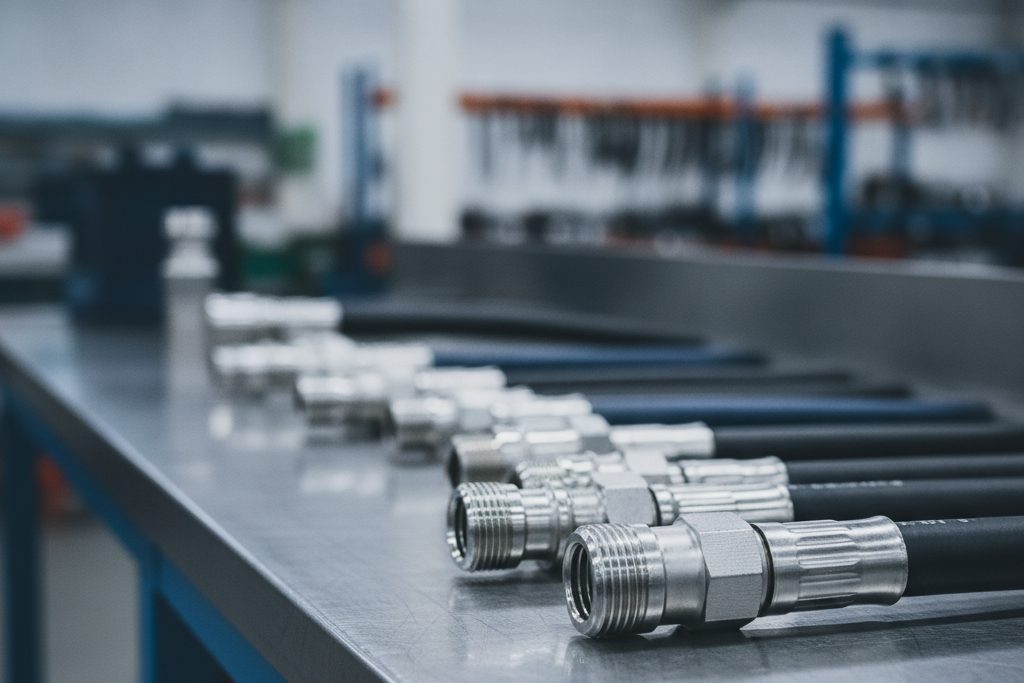
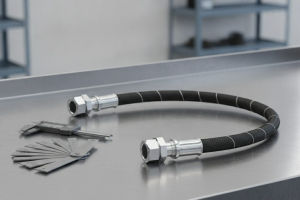
Choosing the right fitting matters as much as choosing the right hose. A hydraulic hose assembly is only as reliable as its weakest connection, and pairing a hose with the wrong fitting can quietly lower its pressure rating and lead to failure. This guide walks you through how fitting compatibility works and how to match the right fitting to your hose series.
What you’ll learn
- Why compatibility affects pressure: how the wrong fitting can reduce your hose’s rated pressure.
- The main fitting types: Global, Global TTC, shank type combination nipples, and crimped fittings, and where each one fits.
- How to match a fitting to your hose: the specs to confirm before you order.
- Compatibility by hose series: the details for common Aeroquip hose series.
- Answers to common questions: the ones we hear most from customers.
Why fitting compatibility matters
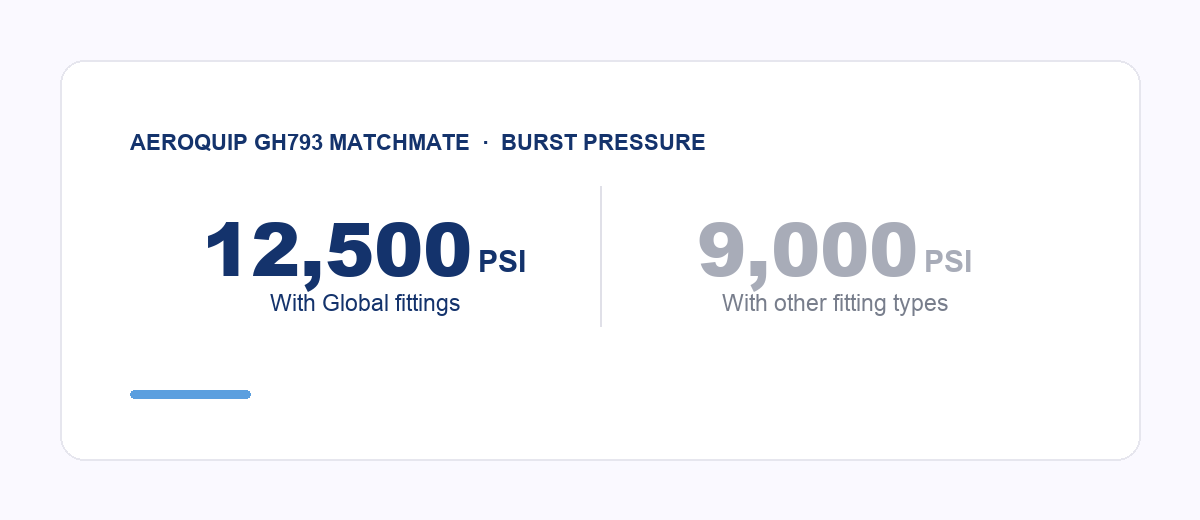
A hose’s rated working pressure assumes it is paired with a compatible fitting. When a non-specified fitting is used, that rating may no longer apply. On hoses like the Aeroquip GH793 MatchMate series, for example, burst pressure reaches 12,500 PSI with Global fittings but drops to 9,000 PSI with other fitting types. That difference matters most in high-pressure applications, where operating conditions push against the rated limits.
Fitting compatibility affects more than pressure ratings. Thread type, end configuration, and installation method all need to align with the hose series and the port or component being connected. Getting that right before assembly saves time, reduces the risk of rework, and keeps the system performing as specified.
Fitting types overview
Global fittings
Global fittings are a widely used standard in hydraulic hose assemblies and are the specified fitting type for several Aeroquip hose series, including the GH793 MatchMate. When a product page lists a burst pressure that applies specifically with Global fittings, using a different fitting type will reduce that rating. Global fittings are available in a range of thread configurations and end types to suit most industrial and mobile hydraulic applications.
Global TTC fittings
Global TTC (reusable) fittings are designed for field assembly without the need for specialized crimping equipment. They are compatible with select hose series, including the Aeroquip AQP 2661 suction hose, and are installed using T-Bolt or preformed clamps. Global TTC fittings are a practical choice for maintenance environments where assemblies may need to be made or replaced in the field.
Shank type combination nipples
Shank type combination nipples are commonly used with suction and transfer hose, including SAE 100R4 rated hose. They work in conjunction with clamp-style installation and are suited to lower-pressure suction and return line applications where a reusable, field-serviceable connection is needed.
Crimped fittings
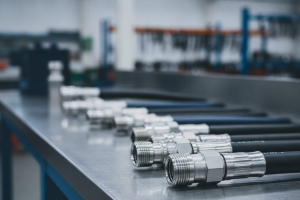
Crimped fittings are the standard for most high-pressure hydraulic hose assemblies. They require a compatible crimping machine and die set matched to the hose series and fitting. Crimped assemblies offer a permanent, reliable connection and are the preferred choice for pressure lines in mobile and industrial hydraulic systems.
How to match fittings to your hose series
Start with the hose manufacturer’s specification. Each hose series has a defined list of compatible fittings, and using a fitting outside that list can affect the assembly’s rated performance. Before you select a fitting, confirm:
- Hose series and dash size: fittings are sized to match the hose inner diameter, so the two have to correspond.
- End connections: the thread type, size, and configuration required on both sides of the assembly.
- System working pressure: whether the fitting type maintains the hose’s full rated pressure.
- Installation method: whether you have a crimping machine in a shop environment or need a field-reusable fitting for maintenance work.
If you are building a new assembly, the hose manufacturer’s fitting compatibility chart is the most reliable starting point. If you are replacing an existing assembly, matching the original fitting specification is the safest approach unless there is a reason to change.
Fitting compatibility by hose series
Here are two common Aeroquip hose series side by side, with the fittings specified for each and a link to view the product.
|
Aeroquip GH793 MatchMate 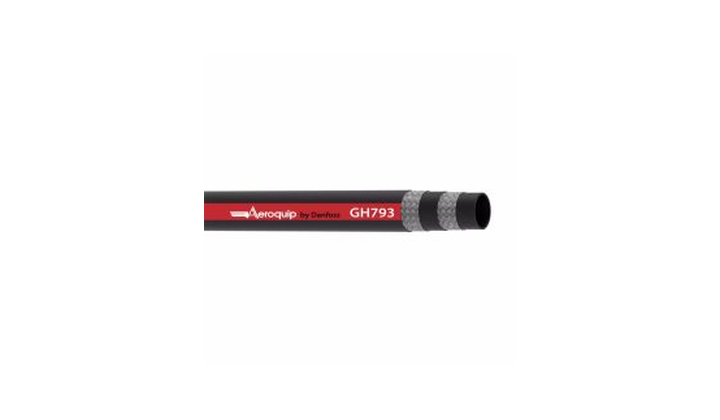
|
Aeroquip AQP 2661 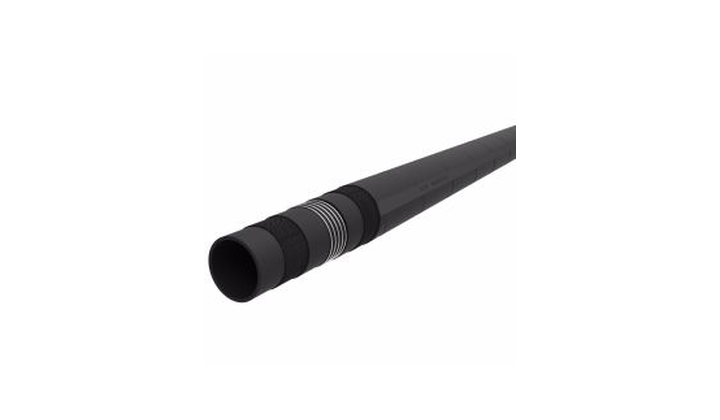
|
FAQs
Does fitting type affect my hose’s pressure rating?
Yes. Many hose series carry a pressure rating that is specific to a designated fitting type. Using a non-specified fitting can reduce the burst pressure rating and may affect the working pressure rating of the assembly. Always confirm fitting compatibility before building or ordering an assembly.
Can I use any brand of fitting with my Aeroquip hose?
Aeroquip hose series are typically specified with Aeroquip or Global fittings so the assembly meets its published pressure ratings. Using third-party fittings may affect performance and could void any applicable product warranty. When in doubt, check the manufacturer’s compatibility documentation or contact us for guidance.
What’s the difference between Global and Global TTC fittings?
Global fittings are typically crimped onto the hose with a crimping machine and are the standard for permanent, high-pressure assemblies. Global TTC fittings are reusable and designed for field installation without crimping equipment, which makes them better suited to maintenance work or applications where assemblies need to be replaced in the field.
How do I know which dash size fitting to order?
Fitting dash size corresponds to the hose inner diameter. A -12 dash size fitting is designed for a 0.75 inch ID hose, and a -16 dash size fitting is designed for a 1.00 inch ID hose. Always match the fitting dash size to the hose dash size unless the manufacturer’s specification indicates otherwise.
What if I need help selecting a fitting for my application?
Send us your hose series, dash size, system pressure, and end connection requirements and we can help confirm the right fitting for your application. Contact our team and we’ll take it from there.
Still not sure which fitting your assembly needs? Contact our team with your hose series, dash size, and system pressure, and we’ll confirm the right fitting for the job.

Share on Facebook

Share on X

Share on Pinterest
Quick Add Product
Account Summary
Short Code:
Credit Limit:
Current Balance:
Recent Posts


Tell us what you need and we'll get back to you.
Fields marked * are required.
Thanks — your inquiry's on its way