
-
All Products
- Hydraulic Power Systems & Components
- Shop all
- Hydraulic Pumps & Accessories
- Hydraulic Motors & Accessories
- Hydrostatic Transmissions
- Cylinders & Accessories
- Steering Units & Accessories
- Hydraulic Valves & Accessories
- Shop all
- Ball Valves
- Check Valves
- Check Valves (Pilot-Operated)
- Counterbalance Valves (Overcenter Valves)
- Cushion Valves (Double Relief Valves)
- Directional Control Valves
- Flow Control Valves
- Flow Divider Valves
- Gate Valves
- Logic Element Valves
- Needle Valves
- Plug Valves
- Pressure Reducing Valves
- Relief Valves
- Sandwich Valves
- Premium Selector Valves
- Slip-In Cartridge Valves
- Premium Stack Valves
- System Accessory Valves
- Premium Truck Valves
- Valve Accessories
- Electronic Control Components
- Pressure Sequence Valves
- Screw-In Cartridge Valves
- Motion Control Valves
- Shop Logic Element Valves
- Unloading Valves
- Drain Valves
- Hydraulic Filters & Accessories
- Power Units
- System Accessories
- High Force Hydraulics
- Pneumatic Power & Control
- Shop all
- Pneumatic Cylinders
- Pneumatic Valves & Accessories
- Pneumatic Air Line Filter, Regulator, & Lubicator (FRL's)
- Pneumatic Air Line Filters
- Premium Air Tool Hose Assemblies
- Air Line Lubricating Oil
- Safety Pop-Off Valves
- Pneumatic Air Line Filter & Regulator
- Pneumatic Air Line Filter Accessories
- Pneumatic Air Line Lubricators
- Pneumatic Air Tools
- Pneumatic Air Line Filter, Regulator, & Lubricator (FRL's)
- Pneumatic Air Line Regulators
- Pneumatic Cylinder Accessories
- Fluid Conveying
- Shop all
- Hose Products
- Tubing Products
- Piping Products
- Adapters
- Shop all
- Steel
- Shop all
- O-Ring Face Seal Braze Adapters
- O-Ring Face Seal To Straight Thread O-Ring
- O-Ring Face Seal To Pipe
- O-Ring Face Seal To 37° Flare
- O-Ring Face Seal To O-Ring Face Seal
- O-Ring Face Seal Accessories
- Pipe To Pipe
- Pipe to 37° Flare
- Pipe To Straight Thread O-Ring
- Pipe To Hose
- 37° Flare Union
- Straight Thread O-Ring to 37° Flare
- Straight Thread O-Ring to Straight Thread O-Ring
- Straight Thread O-Ring to Hose
- SAE Split Flange To 37° Flare
- SAE Split Flange To O-Ring Face Seal
- Braze & Weld to 37° Flare
- 42° Inverted Flare to 37° Flare
- Restrictor
- Metric to 37° Flare
- Metric to Pipe
- Metric
- BSPP to 37° Flare
- BSPP to Pipe
- BSPP to Metric
- BSPP to BSPT
- BSPP
- BSPT To Pipe
- BSPT To 37° Flare
- JIS
- JIS 30° Seat (BSPP Thread) To 37° Flare
- Komatsu, Kobelco
- BSPP to 37 deg Flare
- BSPT To JIS
- 37 deg Flare Union
- Pipe to 37 deg Flare
- Straight Thread O-Ring to 37 deg Flare
- O-Ring Face Seal To BSPP
- SAE Split Flange To 37 deg Flare
- Straight Thread O-Ring to Metric
- Metric to 37 deg Flare
- Straight Thread O-Ring to Pipe
- 37 deg Flare Plug
- BSPT To 37 deg Flare
- JIS 30 deg Seat (BSPP Thread) To 37 deg Flare
- O-Ring Face Seal To JIS
- Straight Thread O-Ring to BSPP
- O-Ring Face Seal To Metric
- SAE Split Flange To Pipe
- Auxiliary Components
- O-Ring Face Seal To 37 deg Flare
- Straight Thread O-Ring to JIS
- Braze & Weld to 37 deg Flare
- Metric to BSPT
- Pipe To STC (Snap to Connect)
- BSPP To Hose
- Flareless Fittings
- Braze & Weld to Pipe
- SAE Split Flange To SAE Split Flange
- SAE Split Flange To Straight Thread O-Ring
- 42 deg Inverted Flare Union & Accessories
- Push-to-Connect To STC (Snap to Connect)
- O-Ring Face Seal To STC (Snap to Connect)
- BSPT
- Pipe To 30 deg Flare
- SAE Split Flange Braze Adapters
- BSPT To Hose
- 42 deg Inverted Flare to 37 deg Flare
- Push-On to 37 deg Flare
- O-Ring Face Seal To Hose
- Stainless Steel
- Shop all
- Pipe To Pipe
- Pipe To 37° Flare
- 37° Flare Union
- Straight Thread O-Ring To 37° Flare
- Metric To 37° Flare
- BSPP To 37° Flare
- Auxiliary Components
- Metric
- BSPP
- 37 deg Flare Union
- BSPP To Pipe
- Straight Thread O-Ring To Pipe
- Pipe To 37 deg Flare
- BSPP To 37 deg Flare
- Metric To Pipe
- Metric To 37 deg Flare
- BSPP To Metric
- O-Ring Face Seal To Pipe
- Straight Thread O-Ring To 37 deg Flare
- BSPT To 37 deg Flare
- O-Ring Face Seal To Straight Thread O-Ring
- Straight Thread O-Ring To Straight Thread O-Ring
- SAE Split Flange To 37 deg Flare
- Pipe To Hose
- 37 deg Flare To Hose
- O-Ring Face Seal To O-Ring Face Seal
- 37 deg Flare Plug
- Straight Thread O-Ring To BSPP
- Braze & Weld to Pipe
- Metric to BSPT
- BSPT To Pipe
- BSPT
- Brass
- Shop all
- Pipe To Pipe
- Pipe To 37° Flare
- Pipe To 45° Flare
- 45° Flare Union
- 42° Inverted Flare To 45° Flare
- 42° Inverted Flare To Pipe
- 42° Inverted Flare Unions & Accessories
- Garden Hose Adapters
- Pipe To 45 deg Flare
- Braze & Weld to Pipe
- 42 deg Inverted Flare To Pipe
- 45 deg Flare Union
- BSPP
- 45 deg Inverted Flare Union
- Pipe To 37 deg Flare
- 37 deg Flare Union
- Pipe To Hose
- BSPP To Pipe
- 37 deg Flare To Hose
- BSPT To Hose
- 42 deg Inverted Flare To 37 deg Flare
- 45 deg Flare To Hose
- 45 deg Inverted Flare To Pipe
- BSPT
- 45 deg Inverted Flare To Hose
- BSPP to BSPT
- 37 deg Flare Plug
- 45 deg Inverted Flare To Tube
- O-Ring Face Seal Braze Adapters
- BSPP To Hose
- BSPT To Pipe
- Metric to Flare
- BSPT To 45 deg Flare
- Metric
- Metric To Pipe
- Stainless Steel Steel
- Hydraulic Quick Disconnects
- Miscellaneous Fluid Conveying Parts
- Shop all
- Flanges
- Metric & BSP Seals & Washers
- Protective Closures
- Split Flange Kits & O-Rings
- Support Clamps
- Swivel Joints
- Air Brake Products
- Hose, Tube & Pipe Cleaning System
- Flange Accessories
- Hose, Tube & Pipe Cleaning System Accessories
- Brake Hose Accessories
- Hose Accessories
- Support Clamp Accessories
- Fitting Assortments
- Performance Parts
- Shop all
- Hose
- Adapters
- Brake System Adapters
- Fuel System Components
- Couplings
- PRO CLAMP and Overbraid
- Accessories
- Reusable Fittings for AQP & Starlite Racing Hose
- Crimp Fittings for AQP & Starlite Racing Hose
- Fittings for AQP Socketless Hose
- Reusable Fittings for Aeroquip FBF A/C Hose
- Fittings for Teflon Racing Hose
- Reusable Fittings for AQP High Pressure Hose
- Assembly Equipment
- Hydraulic Brake Components
- Other Products
- Shop all
- Hydraulic Fluids & Oils for Industrial Systems
- Seals
- Industrial Chemical Maintenance Products
- Lubrication Equipment & Accessories
- Fasteners
- Valves
- Couplings
- Bearings
- Control Cables
- Thread Sealants
- Gloves
- Hand Tools
- Pressure Washer Products for Industrial & Commercial Use
- Hose Reels
- Winches
- Cable Hardware & Knobs
- Cable Remote Controls
- Industrial Corrosion Inhibitors
- Y Strainer
- Hose Nozzles
- Textbooks
- Cable (Wire) Ties
- Piston Vibrators
- Software Licenses
- Human Machine Interface & Accessories
- Safety Glasses
- Hydraulic Punches & Dies
- Thread Sealant Tapes
- Identification Tools
- Gasket Makers
- Threadlockers
- Tool Storage
- Temperature Controllers & Accessories
- Brazing Rods
- Gear Drives & Accessories
- Gauges
- Drill Bits
- Paint Markers
- Switches & Accessories
- Power Tools
- Cut-Off Wheels
- Work Lights
- Cleaning Cloths & Towels
- Hose Reel Accessories
- Labels
- Flashlights
- Shirts
- Pipe Wrapping Tapes
- Batteries
- Winch Parts & Accessories
- Pen Lights
- Hydraulic Power Systems & Components
-
Services
- 24/7 On-Site Mobile Services
- Control Cable Assemblies
- Crimper Maintenance Program
- Custom Hydraulic Components Fabrication
- Cut & Weld
- Danfoss x20 Stock Change Program
- Engineering Center Services
- Hose Kitting Services
- HPU Build Program
- Hydraulic & Industrial Hose Assemblies
- Hydraulic Repair & Service
- Tube Bending Services
- Vane Pump Build Program
- View All Services
- Branch Locations
- Catalogs
- Help
- Quick Order
SAME DAY SHIPPING
— Order by 2pm EST.
How to Replace a Hydraulic Hose: Step-by-Step Guide
Published October 08, 2026 | Last Updated October 13, 2026
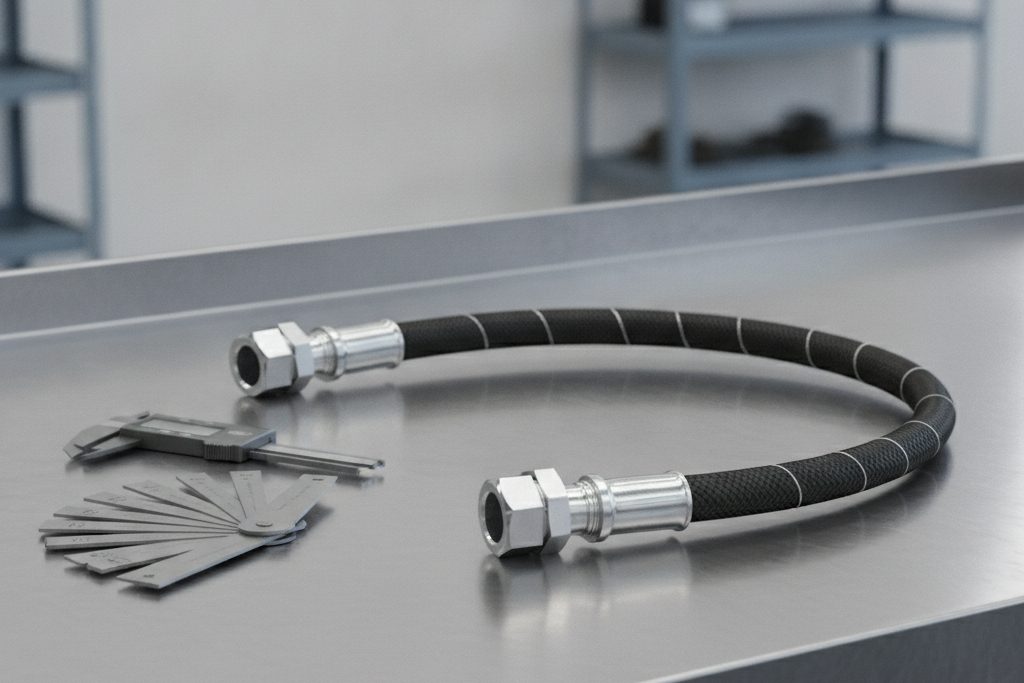
A hose failure doesn't leave much time for research. Equipment is down, fluid is on the ground, and the priority is getting a correct replacement built fast, not just any hose that looks close enough.
This guide walks through how to replace a hydraulic hose from start to finish: identifying the fitting on your failed assembly, selecting the right hose using the STAMP method, matching crimp specs correctly, and protecting the new assembly so it doesn't fail again.
If you'd rather skip the process entirely, Hydraulic Supply Company builds custom hose assemblies at more than 40 branch locations, and dispatches mobile service when the equipment can't come to us.
Start With the Fitting You Already Have
Before ordering a replacement hose, look closely at the failed assembly, sometimes called the hose assembly on a parts list or work order. Two things matter most: where the failure happened, at the fitting, at the crimp, or along the hose body, and what thread type is on each end.
Fitting identification off a damaged assembly can be difficult, especially if the failure point is the fitting itself. Measure what's left with a thread pitch gauge and caliper, or send us a photo and our specialists will identify it for you. For a full breakdown of thread types including JIC, NPT, NPTF, ORFS, ORB, BSPP, and metric, see our Hydraulic Fittings guide.
Safety warning: Never check a pressurized hydraulic line for a leak with your bare hand. A pinhole leak can inject fluid into the skin at pressures far beyond what tissue can withstand, and the entry wound often looks minor even when the injury underneath is severe. Use a piece of cardboard or wood to check for leaks instead, and treat any suspected high-pressure fluid injection as a medical emergency, regardless of how the wound appears.
Selecting a Replacement Hose: The STAMP Method
STAMP is the standard framework fluid power professionals use to select the correct hose. Working through all five factors, rather than just matching size, is what prevents a replacement from failing again under the same conditions that took out the original.
Size
Size refers to the hose's inside diameter, measured in dash sizes, where each increment equals 1/16 inch. Match the original hose's dash size unless you have a specific reason to upsize for improved flow or downsize for a tighter routing path.
Temperature
Two temperature ranges matter: the temperature of the fluid running through the hose, and the ambient temperature the hose is exposed to externally. A hose routed near an engine or exhaust manifold needs to tolerate ambient heat well above the fluid's own operating temperature.
Application
Application covers how and where the hose is routed, including minimum bend radius, whether the installation is static or subject to constant flexing, and exposure to abrasion from nearby components or rough surfaces. Undersized bend radius is one of the most common causes of premature hose failure. This matters just as much replacing a hydraulic hose on a tractor loader arm as it does on a stationary press.
Media
Media is the fluid the hose will carry, petroleum-based hydraulic oil, water-glycol, phosphate ester fire-resistant fluid, or others. Using a hose not rated for the specific fluid type leads to internal degradation, even if the size and pressure rating are otherwise correct.
Pressure
Pressure covers both the maximum working pressure the hose must handle and its burst rating, which typically carries a 4:1 safety factor over working pressure. Check your equipment's documentation or the layline printed on the original hose to confirm the rated working pressure before ordering.
Once you know your spec, browse Hydraulic Hose by type, or explore Marine Hose and Special Application Hose for non-standard environments.
Matching Crimp Specs to Your Hose and Fitting
Crimp specifications are not universal. The correct crimp diameter depends on the specific combination of hose, fitting, and manufacturer, and using a generic or approximate crimp spec can result in a fitting that looks properly attached but leaks or blows off under pressure.
If you're crimping in-house, confirm the exact spec from the hose and fitting manufacturer's published crimp charts before running the machine. Browse Assembly Equipment for crimpers and related tools, or explore Hose Fittings and Tube Fittings to confirm you have the correct fitting for your hose before crimping.
Hose Protection and Clamps
A correctly selected and crimped assembly can still fail early without proper protection. Abrasion sleeves and spring guards prevent wear at contact points and tight bends, while correctly spaced clamps reduce vibration fatigue along the length of the run, one of the most common root causes behind hoses that fail again shortly after replacement.
Browse Hose Protection and Hose Clamps & Crimp Ferrules to prevent a repeat failure.
Do It Yourself, or Let HSC Handle Onsite Hydraulic Hose Repair
Order Online Have your spec and just need the parts? Shop Hydraulic Hose and Hose Fittings directly.
Visit a Branch Skip the DIY process entirely. Hydraulic Supply Company builds while-you-wait hose assemblies at more than 40 branch locations, using Danfoss Aeroquip, Eaton, SSP, Kuriyama, and other manufacturer specs. Find a Branch
Onsite / Mobile Service If the equipment can't be moved, HSC dispatches mobile technicians carrying hose stock, fittings, and crimping equipment directly to your job site for onsite hydraulic hose repair, 24/7 including weekends and holidays. Schedule Mobile Service
Managing hose replacement across a fleet or standardizing assemblies for recurring builds? See our Hose & Components Kitting service.
Verify the Installation
A correctly built assembly can still fail if it's not verified after install. Before returning equipment to full operation, bring the system up to low pressure first and check every connection for leaks before moving to full operating pressure. Once the machine is running, check the hose routing again under actual movement and load, since a bend radius that looked fine at rest can pinch or rub once the machine is in motion.
If you're using reusable fittings, confirm proper torque specifically. Over-tightening a reusable fitting can cut or pinch the o-ring rather than seal it, causing a leak that only appears once the system is under pressure.
Hose Brands We Carry
Aeroquip: Hydraulic Supply Company is a certified Danfoss Aeroquip Hose Center, and Aeroquip is our primary line for hose and matched fitting systems. Shop Aeroquip
Gates: A broad line of hydraulic and industrial hose built for demanding mobile and industrial applications. Shop Gates
Frequently Asked Questions
What's the difference between wire braid and spiral hose?
Wire braid hose uses one or two layers of braided reinforcement and offers a tighter bend radius, making it a common choice for lower and medium pressure applications. Spiral hose uses four to six layers of spiral-wound wire, handles higher pressure, and is more rugged, but requires a larger minimum bend radius.
Can I reuse the fittings from my old hose assembly?
Generally, no. Crimped fittings and ferrules are permanently deformed during the crimping process and are not designed for reuse. Reusable-style fittings are the exception, and can be removed and reinstalled without a crimping machine.
How do I know what pressure rating I need?
Check your equipment's documentation for the system's rated working pressure, or read the layline printed along the original hose, which typically lists the working pressure. The replacement hose should meet or exceed that rating.
How do I replace a hydraulic hose on a tractor?
The process is the same as any other assembly: identify the fitting, select the replacement using STAMP, and match the crimp spec, but pay extra attention to bend radius and abrasion protection on loader arms and other points that flex under load. If the equipment can't be trailered in, HSC's mobile service can build and install the assembly on-site.
Do you offer same-day hose assembly?
Yes. Most branch locations build while-you-wait hose assemblies using in-house crimping equipment. Contact your nearest branch to confirm availability for your specific hose and fitting combination.
What if my equipment can't be brought to a branch?
Hydraulic Supply Company offers onsite hydraulic hose repair, with mobile technicians who carry hose stock, common fittings, and crimping equipment to fabricate and replace failed assemblies at your location, available 24/7 including weekends and holidays.
Need it built fast? Find a Branch near you for while-you-wait hose assembly.
Equipment down and can't be moved? Schedule Mobile Service for 24/7 onsite hose repair and replacement.

Share on Facebook

Share on X

Share on Pinterest
Quick Add Product
Account Summary
Short Code:
Credit Limit:
Current Balance:
Recent Posts

Tell us what you need and we'll get back to you.
Fields marked * are required.
Thanks — your inquiry's on its way