
-
All Products
- Hydraulic Power Systems & Components
- Shop all
- Hydraulic Pumps & Accessories
- Hydraulic Motors & Accessories
- Hydrostatic Transmissions
- Cylinders & Accessories
- Steering Units & Accessories
- Hydraulic Valves & Accessories
- Shop all
- Ball Valves
- Check Valves
- Check Valves (Pilot-Operated)
- Counterbalance Valves (Overcenter Valves)
- Cushion Valves (Double Relief Valves)
- Directional Control Valves
- Flow Control Valves
- Flow Divider Valves
- Gate Valves
- Logic Element Valves
- Needle Valves
- Plug Valves
- Pressure Reducing Valves
- Relief Valves
- Sandwich Valves
- Premium Selector Valves
- Slip-In Cartridge Valves
- Premium Stack Valves
- System Accessory Valves
- Premium Truck Valves
- Valve Accessories
- Electronic Control Components
- Pressure Sequence Valves
- Screw-In Cartridge Valves
- Motion Control Valves
- Shop Logic Element Valves
- Unloading Valves
- Drain Valves
- Hydraulic Filters & Accessories
- Power Units
- System Accessories
- High Force Hydraulics
- Pneumatic Power & Control
- Shop all
- Pneumatic Cylinders
- Pneumatic Valves & Accessories
- Pneumatic Air Line Filter, Regulator, & Lubicator (FRL's)
- Pneumatic Air Line Filters
- Premium Air Tool Hose Assemblies
- Air Line Lubricating Oil
- Safety Pop-Off Valves
- Pneumatic Air Line Filter & Regulator
- Pneumatic Air Line Filter Accessories
- Pneumatic Air Line Lubricators
- Pneumatic Air Tools
- Pneumatic Air Line Filter, Regulator, & Lubricator (FRL's)
- Pneumatic Air Line Regulators
- Pneumatic Cylinder Accessories
- Fluid Conveying
- Shop all
- Hose Products
- Tubing Products
- Piping Products
- Adapters
- Shop all
- Steel
- Shop all
- O-Ring Face Seal Braze Adapters
- O-Ring Face Seal To Straight Thread O-Ring
- O-Ring Face Seal To Pipe
- O-Ring Face Seal To 37° Flare
- O-Ring Face Seal To O-Ring Face Seal
- O-Ring Face Seal Accessories
- Pipe To Pipe
- Pipe to 37° Flare
- Pipe To Straight Thread O-Ring
- Pipe To Hose
- 37° Flare Union
- Straight Thread O-Ring to 37° Flare
- Straight Thread O-Ring to Straight Thread O-Ring
- Straight Thread O-Ring to Hose
- SAE Split Flange To 37° Flare
- SAE Split Flange To O-Ring Face Seal
- Braze & Weld to 37° Flare
- 42° Inverted Flare to 37° Flare
- Restrictor
- Metric to 37° Flare
- Metric to Pipe
- Metric
- BSPP to 37° Flare
- BSPP to Pipe
- BSPP to Metric
- BSPP to BSPT
- BSPP
- BSPT To Pipe
- BSPT To 37° Flare
- JIS
- JIS 30° Seat (BSPP Thread) To 37° Flare
- Komatsu, Kobelco
- BSPP to 37 deg Flare
- BSPT To JIS
- 37 deg Flare Union
- Pipe to 37 deg Flare
- Straight Thread O-Ring to 37 deg Flare
- O-Ring Face Seal To BSPP
- SAE Split Flange To 37 deg Flare
- Straight Thread O-Ring to Metric
- Metric to 37 deg Flare
- Straight Thread O-Ring to Pipe
- 37 deg Flare Plug
- BSPT To 37 deg Flare
- JIS 30 deg Seat (BSPP Thread) To 37 deg Flare
- O-Ring Face Seal To JIS
- Straight Thread O-Ring to BSPP
- O-Ring Face Seal To Metric
- SAE Split Flange To Pipe
- Auxiliary Components
- O-Ring Face Seal To 37 deg Flare
- Straight Thread O-Ring to JIS
- Braze & Weld to 37 deg Flare
- Metric to BSPT
- Pipe To STC (Snap to Connect)
- BSPP To Hose
- Flareless Fittings
- Braze & Weld to Pipe
- SAE Split Flange To SAE Split Flange
- SAE Split Flange To Straight Thread O-Ring
- 42 deg Inverted Flare Union & Accessories
- Push-to-Connect To STC (Snap to Connect)
- O-Ring Face Seal To STC (Snap to Connect)
- BSPT
- Pipe To 30 deg Flare
- SAE Split Flange Braze Adapters
- BSPT To Hose
- 42 deg Inverted Flare to 37 deg Flare
- Push-On to 37 deg Flare
- O-Ring Face Seal To Hose
- Stainless Steel
- Shop all
- Pipe To Pipe
- Pipe To 37° Flare
- 37° Flare Union
- Straight Thread O-Ring To 37° Flare
- Metric To 37° Flare
- BSPP To 37° Flare
- Auxiliary Components
- Metric
- BSPP
- 37 deg Flare Union
- BSPP To Pipe
- Straight Thread O-Ring To Pipe
- Pipe To 37 deg Flare
- BSPP To 37 deg Flare
- Metric To Pipe
- Metric To 37 deg Flare
- BSPP To Metric
- O-Ring Face Seal To Pipe
- Straight Thread O-Ring To 37 deg Flare
- BSPT To 37 deg Flare
- O-Ring Face Seal To Straight Thread O-Ring
- Straight Thread O-Ring To Straight Thread O-Ring
- SAE Split Flange To 37 deg Flare
- Pipe To Hose
- 37 deg Flare To Hose
- O-Ring Face Seal To O-Ring Face Seal
- 37 deg Flare Plug
- Straight Thread O-Ring To BSPP
- Braze & Weld to Pipe
- Metric to BSPT
- BSPT To Pipe
- BSPT
- Braze & Weld to 37 deg Flare
- Brass
- Shop all
- Pipe To Pipe
- Pipe To 37° Flare
- Pipe To 45° Flare
- 45° Flare Union
- 42° Inverted Flare To 45° Flare
- 42° Inverted Flare To Pipe
- 42° Inverted Flare Unions & Accessories
- Garden Hose Adapters
- Pipe To 45 deg Flare
- Braze & Weld to Pipe
- 42 deg Inverted Flare To Pipe
- 45 deg Flare Union
- BSPP
- 45 deg Inverted Flare Union
- Pipe To 37 deg Flare
- 37 deg Flare Union
- Pipe To Hose
- BSPP To Pipe
- 37 deg Flare To Hose
- BSPT To Hose
- 42 deg Inverted Flare To 37 deg Flare
- 45 deg Flare To Hose
- 45 deg Inverted Flare To Pipe
- BSPT
- 45 deg Inverted Flare To Hose
- BSPP to BSPT
- 37 deg Flare Plug
- 45 deg Inverted Flare To Tube
- O-Ring Face Seal Braze Adapters
- BSPP To Hose
- BSPT To Pipe
- Metric to Flare
- BSPT To 45 deg Flare
- Metric
- Metric To Pipe
- Hydraulic Quick Disconnects
- Miscellaneous Fluid Conveying Parts
- Shop all
- Flanges
- Metric & BSP Seals & Washers
- Protective Closures
- Split Flange Kits & O-Rings
- Support Clamps
- Swivel Joints
- Air Brake Products
- Hose, Tube & Pipe Cleaning System
- Flange Accessories
- Hose, Tube & Pipe Cleaning System Accessories
- Brake Hose Accessories
- Hose Accessories
- Support Clamp Accessories
- Fitting Assortments
- Performance Parts
- Shop all
- Hose
- Adapters
- Brake System Adapters
- Fuel System Components
- Couplings
- PRO CLAMP and Overbraid
- Accessories
- Reusable Fittings for AQP & Starlite Racing Hose
- Crimp Fittings for AQP & Starlite Racing Hose
- Fittings for AQP Socketless Hose
- Reusable Fittings for Aeroquip FBF A/C Hose
- Fittings for Teflon Racing Hose
- Reusable Fittings for AQP High Pressure Hose
- Assembly Equipment
- Hydraulic Brake Components
- Other Products
- Shop all
- Hydraulic Fluids & Oils for Industrial Systems
- Seals
- Industrial Chemical Maintenance Products
- Lubrication Equipment & Accessories
- Fasteners
- Valves
- Couplings
- Control Cables
- Thread Sealants
- Gloves
- Hand Tools
- Pressure Washer Products for Industrial & Commercial Use
- Hose Reels
- Winches
- Cable Hardware & Knobs
- Cable Remote Controls
- Industrial Corrosion Inhibitors
- Y Strainer
- Hose Nozzles
- Textbooks
- Cable (Wire) Ties
- Piston Vibrators
- Software Licenses
- Human Machine Interface & Accessories
- Safety Glasses
- Hydraulic Punches & Dies
- Thread Sealant Tapes
- Identification Tools
- Gasket Makers
- Threadlockers
- Tool Storage
- Temperature Controllers & Accessories
- Brazing Rods
- Gear Drives & Accessories
- Gauges
- Drill Bits
- Paint Markers
- Switches & Accessories
- Power Tools
- Cut-Off Wheels
- Work Lights
- Cleaning Cloths & Towels
- Hose Reel Accessories
- Labels
- Flashlights
- Pipe Wrapping Tapes
- Batteries
- Winch Parts & Accessories
- Pen Lights
- Hydraulic Power Systems & Components
-
Services
- 24/7 On-Site Mobile Services
- Control Cable Assemblies
- Crimper Maintenance Program
- Custom Hydraulic Components Fabrication
- Cut & Weld
- Danfoss x20 Stock Change Program
- Engineering Center Services
- Hose Kitting Services
- HPU Build Program
- Hydraulic & Industrial Hose Assemblies
- Hydraulic Repair & Service
- Tube Bending Services
- Vane Pump Build Program
- View All Services
- Branch Locations
- Catalogs
- Help
- Quick Order
SAME DAY SHIPPING
— Order by 2pm ET.
Hydraulic Pump Cavitation: Causes, Symptoms, and How to Fix It
Published November 23, 2026 | Last Updated November 23, 2026
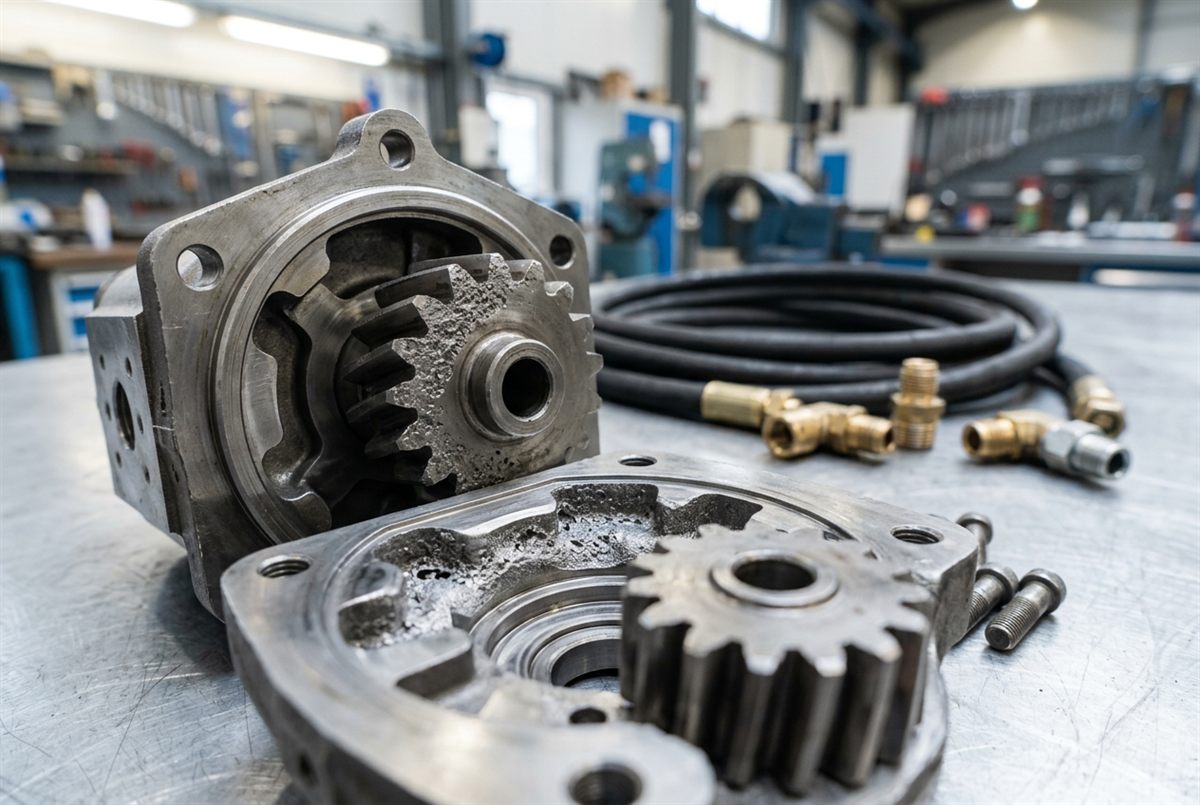
A hydraulic pump that suddenly starts whining is telling you something, and it usually isn't that the pump is worn out. In most cases, the pump is being starved. Something on the suction side is keeping fluid from reaching the pump inlet freely, and the pump is paying for it with every revolution. That condition is called cavitation, and left alone, it will destroy a healthy pump from the inside.
The good news is that hydraulic pump cavitation is usually cheap to fix once you know where to look. The causes almost always sit between the reservoir and the pump inlet, and many of them are a strainer, a hose, or a breather away from being solved.
What Is Pump Cavitation?
Pump cavitation happens when the pressure at the pump inlet drops so low that the hydraulic fluid begins to vaporize. Small vapor bubbles form in the low-pressure zone at the inlet. As the pump carries those bubbles toward the high-pressure outlet, the rising pressure makes them collapse violently. Each collapse sends a tiny shock wave into the nearby metal surfaces.
One collapse does no harm, but a cavitating pump produces them constantly. Over time, the shock waves erode the pump's internal surfaces, leaving a pitted, sandblasted look on the parts near the inlet-to-outlet transition. Low inlet pressure also pulls dissolved air out of the fluid, adding to the bubbles and the damage.
Pump Cavitation Symptoms
The most common sign of cavitation is noise. A cavitating hydraulic pump typically produces a steady, high-pitched whine that gets louder as pump speed or demand increases. Other symptoms include:
-
Slow or weak actuators: vapor takes up space that fluid should fill, so the pump delivers less flow than it should.
-
Excess heat: the energy released by collapsing bubbles ends up as heat in the fluid and the pump.
-
Noise that fades as the machine warms up: a strong clue that cold, thick fluid is struggling to reach the inlet.
-
Pitting on pump internals: found when a pump is opened for service, this is the physical proof of cavitation.
Cavitation vs. Aeration: Two Problems That Sound Alike
Cavitation and aeration are often confused because both put bubbles in the fluid and both make a pump noisy. The difference is where the bubbles come from, and that difference decides the fix.
-
Cavitation is fluid vaporizing because the pump inlet is starved. It tends to produce a steady, high-pitched whine. The fix is to reduce inlet restriction.
-
Aeration is outside air getting into the fluid. It tends to produce an erratic knocking or rattling sound, often with foamy or milky fluid in the reservoir and spongy, jerky actuator movement. The fix is to find and stop the air leak.
Both problems damage pumps, and a system can have both at once. Checking for each one separately saves you from replacing parts that were never the problem.
What Causes Cavitation in Hydraulic Pumps?
Anything that restricts flow into the pump inlet can cause cavitation. The usual suspects, starting at the reservoir:
-
A clogged or undersized suction strainer. Suction strainers protect the pump from debris, but a strainer loaded with contamination, or one too small for the pump's flow, becomes a restriction in its own right.
-
A blocked breather. As the pump draws fluid down, air has to enter the reservoir to replace it. A clogged breather or filler-breather lets vacuum build in the tank, and that vacuum works directly against the pump inlet.
-
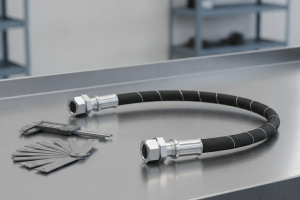
A collapsed, kinked, or undersized suction hose. Suction lines run under vacuum, so standard pressure hose can collapse internally without looking damaged from the outside. The suction line needs wire-reinforced suction hose sized to the pump inlet, routed with gentle bends and as few fittings as possible.
-
Cold or high-viscosity fluid. Thick fluid resists flowing into the pump. A pump that screams on a cold morning and quiets down once the system warms is cavitating on viscosity. Check that the hydraulic fluid grade matches the operating temperatures.
-
Low fluid level. When the level drops too far, the pump can pull in a vortex of air at the outlet, or even uncover the strainer.
-
A partially closed suction shutoff valve. Any valve on the suction line should be fully open during operation.
-
Pump speed or lift beyond the inlet's capacity. Running a pump faster than its inlet conditions allow, or mounting it too far above the fluid level, can starve it even when every component is in good shape.
How to Diagnose Pump Cavitation
Work from the reservoir toward the pump, because that is the path the fluid takes:
-
Check the fluid. Confirm the level is correct and look at the fluid itself. Foamy or milky fluid points toward aeration or water contamination rather than pure cavitation.
-
Check the breather. Remove or open the breather briefly while the system runs. If the pump noise drops, the breather was pulling a vacuum on the tank and needs replacement.
-
Inspect the strainer. Pull the suction strainer and look for loading or damage. Confirm it is rated for the pump's flow.
-
Walk the suction line. Look for kinks, soft spots, crushed sections, and hose that isn't a suction-rated type. Check every clamp and fitting between the tank and the pump.
-
Measure inlet vacuum. A vacuum gauge at the pump inlet shows how hard the pump is working to draw fluid. Compare the reading with the pump manufacturer's maximum inlet vacuum rating.
-
Note the timing. Noise that appears only on cold starts points to viscosity. Noise that rises with speed or load points to inlet restriction.
How to Fix and Prevent Hydraulic Pump Cavitation
Most fixes follow directly from the diagnosis:
-
Clean or replace the suction strainer, and upsize it if it was undersized for the pump's flow.
-
Replace the breather with a clean element sized for the reservoir's air exchange.
-
Replace damaged or undersized suction hose with wire-reinforced suction hose matched to the pump inlet, secured with t-bolt clamps.
-
Correct the fluid by topping it off, or switching to a grade that suits the operating temperatures.
-
Open any suction valves fully, and keep the line as short and direct as the machine allows.
-
Keep up with maintenance: scheduled strainer checks and breather changes prevent most cavitation from starting in the first place.
If the noise continues after the suction side checks out, the pump may already be damaged. Our hydraulic repair and service team can inspect it, confirm whether cavitation damage is present, and rebuild or replace it. Browse our hydraulic pumps if replacement is the better path.
Aeration: When Air Gets In, and How to Get It Out
On the suction side, a leak doesn't drip oil. It sucks in air. That's why aeration often goes unnoticed until the pump starts knocking or the fluid turns foamy. Common entry points include:
-
loose hose clamps and worn fittings on the suction line,
-
a failing pump shaft seal,
-
low fluid level, and
-
return lines that discharge above the fluid surface, splashing air into the reservoir.
A quick way to find a suction-side air leak: with the system running, apply a small amount of hydraulic oil around a suspect fitting or clamp. If the pump noise briefly changes, the oil temporarily sealed the leak, and you've found your entry point.
Once the source is fixed, the air still has to come out of the system:
-
Top off the fluid.
-
Run the system at low pressure with no load, cycling each actuator slowly through its full stroke several times so trapped air returns to the reservoir.
-
Give the fluid time to rest so the air can separate before returning to full operation.
Always follow the equipment manufacturer's bleeding procedure where one exists. Cylinders with trapped air often need their own procedure.
Hearing a whine or a knock? Shop suction strainers and wire inserted suction hose, with same day shipping on stocked items ordered by 2pm ET.
Hydraulic Pump Cavitation FAQs
What does pump cavitation sound like?
A cavitating hydraulic pump usually makes a steady, high-pitched whine that gets louder as pump speed or demand increases. Aeration, by contrast, tends to sound more erratic, like knocking or rattling, and is often accompanied by foamy fluid.
What are the most common causes of cavitation in a pump?
The most common causes are a clogged or undersized suction strainer, a blocked reservoir breather, a collapsed or undersized suction hose, fluid that is too cold or too thick, and low fluid level. All of them restrict flow into the pump inlet.
Can cavitation damage a hydraulic pump?
Yes. Collapsing vapor bubbles erode the pump's internal surfaces, causing pitting, lost efficiency, heat, and eventually pump failure. Fixing the suction-side cause early prevents the damage from progressing.
Why is my hydraulic oil foaming?
Foaming usually means air is entering the fluid. Common causes are an air leak on the suction side, low fluid level, a return line discharging above the fluid surface, or degraded fluid that has lost its anti-foam additives. Water contamination can also make fluid look milky.
How do you get air out of a hydraulic system?
First, fix the source of the air leak. Then top off the fluid and run the system at low pressure with no load, cycling each actuator slowly through its full stroke several times so the air returns to the reservoir. Let the fluid rest before returning to full operation, and follow the manufacturer's bleeding procedure where one exists.
Check the Inlet Before You Replace the Pump
A noisy pump is often a healthy pump fighting a starved inlet, so start with the inexpensive fixes. Shop suction strainers, breathers and filler-breathers, and suction hose, or browse the full range of hydraulic filters and accessories. If the pump has already taken damage, our repair and service team can get it back to work.

Share on Facebook

Share on X

Share on Pinterest
Quick Add Product
Account Summary
Short Code:
Credit Limit:
Current Balance:
Recent Posts
Tell us what you need and we'll get back to you.
Fields marked * are required.
Thanks — your inquiry's on its way