
-
All Products
- Hydraulic Power Systems & Components
- Shop all
- Hydraulic Pumps & Accessories
- Hydraulic Motors & Accessories
- Hydrostatic Transmissions
- Cylinders & Accessories
- Steering Units & Accessories
- Hydraulic Valves & Accessories
- Shop all
- Ball Valves
- Check Valves
- Check Valves (Pilot-Operated)
- Counterbalance Valves (Overcenter Valves)
- Cushion Valves (Double Relief Valves)
- Directional Control Valves
- Flow Control Valves
- Flow Divider Valves
- Gate Valves
- Logic Element Valves
- Needle Valves
- Plug Valves
- Pressure Reducing Valves
- Relief Valves
- Sandwich Valves
- Premium Selector Valves
- Slip-In Cartridge Valves
- Premium Stack Valves
- System Accessory Valves
- Premium Truck Valves
- Valve Accessories
- Electronic Control Components
- Pressure Sequence Valves
- Screw-In Cartridge Valves
- Motion Control Valves
- Shop Logic Element Valves
- Unloading Valves
- Drain Valves
- Hydraulic Filters & Accessories
- Power Units
- System Accessories
- High Force Hydraulics
- Pneumatic Power & Control
- Shop all
- Pneumatic Cylinders
- Pneumatic Valves & Accessories
- Pneumatic Air Line Filter, Regulator, & Lubicator (FRL's)
- Pneumatic Air Line Filters
- Premium Air Tool Hose Assemblies
- Air Line Lubricating Oil
- Safety Pop-Off Valves
- Pneumatic Air Line Filter & Regulator
- Pneumatic Air Line Filter Accessories
- Pneumatic Air Line Lubricators
- Pneumatic Air Tools
- Pneumatic Air Line Filter, Regulator, & Lubricator (FRL's)
- Pneumatic Air Line Regulators
- Pneumatic Cylinder Accessories
- Fluid Conveying
- Shop all
- Hose Products
- Tubing Products
- Piping Products
- Adapters
- Shop all
- Steel
- Shop all
- O-Ring Face Seal Braze Adapters
- O-Ring Face Seal To Straight Thread O-Ring
- O-Ring Face Seal To Pipe
- O-Ring Face Seal To 37° Flare
- O-Ring Face Seal To O-Ring Face Seal
- O-Ring Face Seal Accessories
- Pipe To Pipe
- Pipe to 37° Flare
- Pipe To Straight Thread O-Ring
- Pipe To Hose
- 37° Flare Union
- Straight Thread O-Ring to 37° Flare
- Straight Thread O-Ring to Straight Thread O-Ring
- Straight Thread O-Ring to Hose
- SAE Split Flange To 37° Flare
- SAE Split Flange To O-Ring Face Seal
- Braze & Weld to 37° Flare
- 42° Inverted Flare to 37° Flare
- Restrictor
- Metric to 37° Flare
- Metric to Pipe
- Metric
- BSPP to 37° Flare
- BSPP to Pipe
- BSPP to Metric
- BSPP to BSPT
- BSPP
- BSPT To Pipe
- BSPT To 37° Flare
- JIS
- JIS 30° Seat (BSPP Thread) To 37° Flare
- Komatsu, Kobelco
- BSPP to 37 deg Flare
- BSPT To JIS
- 37 deg Flare Union
- Pipe to 37 deg Flare
- Straight Thread O-Ring to 37 deg Flare
- O-Ring Face Seal To BSPP
- SAE Split Flange To 37 deg Flare
- Straight Thread O-Ring to Metric
- Metric to 37 deg Flare
- Straight Thread O-Ring to Pipe
- 37 deg Flare Plug
- BSPT To 37 deg Flare
- JIS 30 deg Seat (BSPP Thread) To 37 deg Flare
- O-Ring Face Seal To JIS
- Straight Thread O-Ring to BSPP
- O-Ring Face Seal To Metric
- SAE Split Flange To Pipe
- Auxiliary Components
- O-Ring Face Seal To 37 deg Flare
- Straight Thread O-Ring to JIS
- Braze & Weld to 37 deg Flare
- Metric to BSPT
- Pipe To STC (Snap to Connect)
- BSPP To Hose
- Flareless Fittings
- Braze & Weld to Pipe
- SAE Split Flange To SAE Split Flange
- SAE Split Flange To Straight Thread O-Ring
- 42 deg Inverted Flare Union & Accessories
- Push-to-Connect To STC (Snap to Connect)
- O-Ring Face Seal To STC (Snap to Connect)
- BSPT
- Pipe To 30 deg Flare
- SAE Split Flange Braze Adapters
- BSPT To Hose
- 42 deg Inverted Flare to 37 deg Flare
- Push-On to 37 deg Flare
- O-Ring Face Seal To Hose
- Stainless Steel
- Shop all
- Pipe To Pipe
- Pipe To 37° Flare
- 37° Flare Union
- Straight Thread O-Ring To 37° Flare
- Metric To 37° Flare
- BSPP To 37° Flare
- Auxiliary Components
- Metric
- BSPP
- 37 deg Flare Union
- BSPP To Pipe
- Straight Thread O-Ring To Pipe
- Pipe To 37 deg Flare
- BSPP To 37 deg Flare
- Metric To Pipe
- Metric To 37 deg Flare
- BSPP To Metric
- O-Ring Face Seal To Pipe
- Straight Thread O-Ring To 37 deg Flare
- BSPT To 37 deg Flare
- O-Ring Face Seal To Straight Thread O-Ring
- Straight Thread O-Ring To Straight Thread O-Ring
- SAE Split Flange To 37 deg Flare
- Pipe To Hose
- 37 deg Flare To Hose
- O-Ring Face Seal To O-Ring Face Seal
- 37 deg Flare Plug
- Straight Thread O-Ring To BSPP
- Braze & Weld to Pipe
- Metric to BSPT
- BSPT To Pipe
- BSPT
- Braze & Weld to 37 deg Flare
- Brass
- Shop all
- Pipe To Pipe
- Pipe To 37° Flare
- Pipe To 45° Flare
- 45° Flare Union
- 42° Inverted Flare To 45° Flare
- 42° Inverted Flare To Pipe
- 42° Inverted Flare Unions & Accessories
- Garden Hose Adapters
- Pipe To 45 deg Flare
- Braze & Weld to Pipe
- 42 deg Inverted Flare To Pipe
- 45 deg Flare Union
- BSPP
- 45 deg Inverted Flare Union
- Pipe To 37 deg Flare
- 37 deg Flare Union
- Pipe To Hose
- BSPP To Pipe
- 37 deg Flare To Hose
- BSPT To Hose
- 42 deg Inverted Flare To 37 deg Flare
- 45 deg Flare To Hose
- 45 deg Inverted Flare To Pipe
- BSPT
- 45 deg Inverted Flare To Hose
- BSPP to BSPT
- 37 deg Flare Plug
- 45 deg Inverted Flare To Tube
- O-Ring Face Seal Braze Adapters
- BSPP To Hose
- BSPT To Pipe
- Metric to Flare
- BSPT To 45 deg Flare
- Metric
- Metric To Pipe
- Hydraulic Quick Disconnects
- Miscellaneous Fluid Conveying Parts
- Shop all
- Flanges
- Metric & BSP Seals & Washers
- Protective Closures
- Split Flange Kits & O-Rings
- Support Clamps
- Swivel Joints
- Air Brake Products
- Hose, Tube & Pipe Cleaning System
- Flange Accessories
- Hose, Tube & Pipe Cleaning System Accessories
- Brake Hose Accessories
- Hose Accessories
- Support Clamp Accessories
- Fitting Assortments
- Performance Parts
- Shop all
- Hose
- Adapters
- Brake System Adapters
- Fuel System Components
- Couplings
- PRO CLAMP and Overbraid
- Accessories
- Reusable Fittings for AQP & Starlite Racing Hose
- Crimp Fittings for AQP & Starlite Racing Hose
- Fittings for AQP Socketless Hose
- Reusable Fittings for Aeroquip FBF A/C Hose
- Fittings for Teflon Racing Hose
- Reusable Fittings for AQP High Pressure Hose
- Assembly Equipment
- Hydraulic Brake Components
- Other Products
- Shop all
- Hydraulic Fluids & Oils for Industrial Systems
- Seals
- Industrial Chemical Maintenance Products
- Lubrication Equipment & Accessories
- Fasteners
- Valves
- Couplings
- Control Cables
- Thread Sealants
- Gloves
- Hand Tools
- Pressure Washer Products for Industrial & Commercial Use
- Hose Reels
- Winches
- Cable Hardware & Knobs
- Cable Remote Controls
- Industrial Corrosion Inhibitors
- Y Strainer
- Hose Nozzles
- Textbooks
- Cable (Wire) Ties
- Piston Vibrators
- Software Licenses
- Human Machine Interface & Accessories
- Safety Glasses
- Hydraulic Punches & Dies
- Thread Sealant Tapes
- Identification Tools
- Gasket Makers
- Threadlockers
- Tool Storage
- Temperature Controllers & Accessories
- Brazing Rods
- Gear Drives & Accessories
- Gauges
- Drill Bits
- Paint Markers
- Switches & Accessories
- Power Tools
- Cut-Off Wheels
- Work Lights
- Cleaning Cloths & Towels
- Hose Reel Accessories
- Labels
- Flashlights
- Pipe Wrapping Tapes
- Batteries
- Winch Parts & Accessories
- Pen Lights
- Hydraulic Power Systems & Components
-
Services
- 24/7 On-Site Mobile Services
- Control Cable Assemblies
- Crimper Maintenance Program
- Custom Hydraulic Components Fabrication
- Cut & Weld
- Danfoss x20 Stock Change Program
- Engineering Center Services
- Hose Kitting Services
- HPU Build Program
- Hydraulic & Industrial Hose Assemblies
- Hydraulic Repair & Service
- Tube Bending Services
- Vane Pump Build Program
- View All Services
- Branch Locations
- Catalogs
- Help
- Quick Order
SAME DAY SHIPPING
— Order by 2pm EST.
Types of Hydraulic Pumps: How They Work and How to Choose One
Published April 02, 2025 | Last Updated November 12, 2026
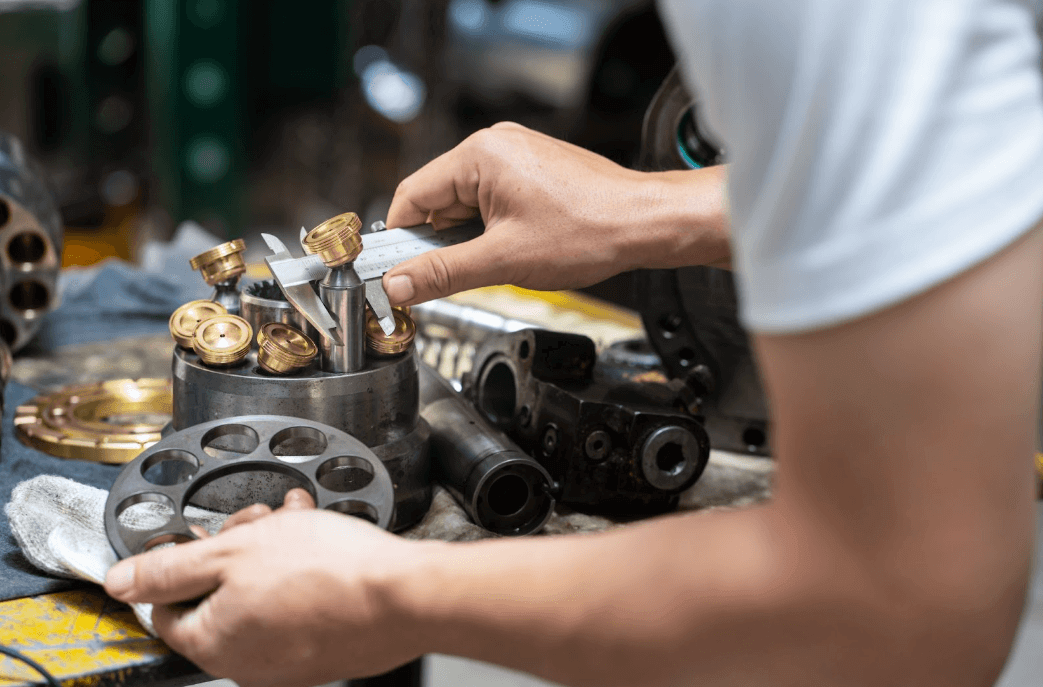
There are three main types of hydraulic pumps: gear pumps, vane pumps, and piston pumps. All three are positive displacement pumps, meaning they trap and move a specific volume of fluid with each cycle. Gear pumps are simple and economical, vane pumps run quietly with smooth flow, and piston pumps handle the highest pressures.
Hydraulic pumps play a vital role in hydraulic systems by converting mechanical energy into hydraulic power. They are responsible for moving fluid to generate the force needed to operate machinery in industries like construction, agriculture, and manufacturing.
Choosing the right hydraulic pump is essential for ensuring optimal performance, reducing downtime, and extending the lifespan of equipment. The wrong pump can lead to inefficiencies, overheating, and unnecessary wear and tear on the system.
This guide covers how hydraulic pumps work, the most common types, how they compare, and how to determine the best option for your application.
What Type of Pump Is a Hydraulic Pump?
A hydraulic pump is a positive displacement pump. It converts mechanical power from an electric motor or engine into hydraulic energy by moving a measured volume of fluid into the system with every rotation. Unlike pumps that simply transfer fluid from one place to another, hydraulic pumps supply the flow that drives cylinders and motors in equipment such as excavators, forklifts, and industrial presses.
How Does a Hydraulic Pump Work?
Every positive displacement hydraulic pump follows the same basic cycle, whether it uses gears, vanes, or pistons:
- Fluid enters the inlet. As the pump's rotating elements turn, they create an expanding chamber on the inlet side. The lower pressure in that chamber allows fluid to flow in from the reservoir.
- Fluid is carried to the outlet. The fluid is trapped between gear teeth, vanes, or pistons and carried from the inlet side to the outlet side of the pump.
- Fluid is pushed into the system. On the outlet side, the chamber shrinks and forces the fluid out into the hydraulic circuit.
- Pressure builds against the load. A pump creates flow, not pressure. Pressure builds only when that flow meets resistance from a cylinder, motor, or valve, and a relief valve limits how high it can go.
The difference between pump types comes down to how they create and seal those moving chambers, which affects pressure capability, efficiency, noise, and cost.
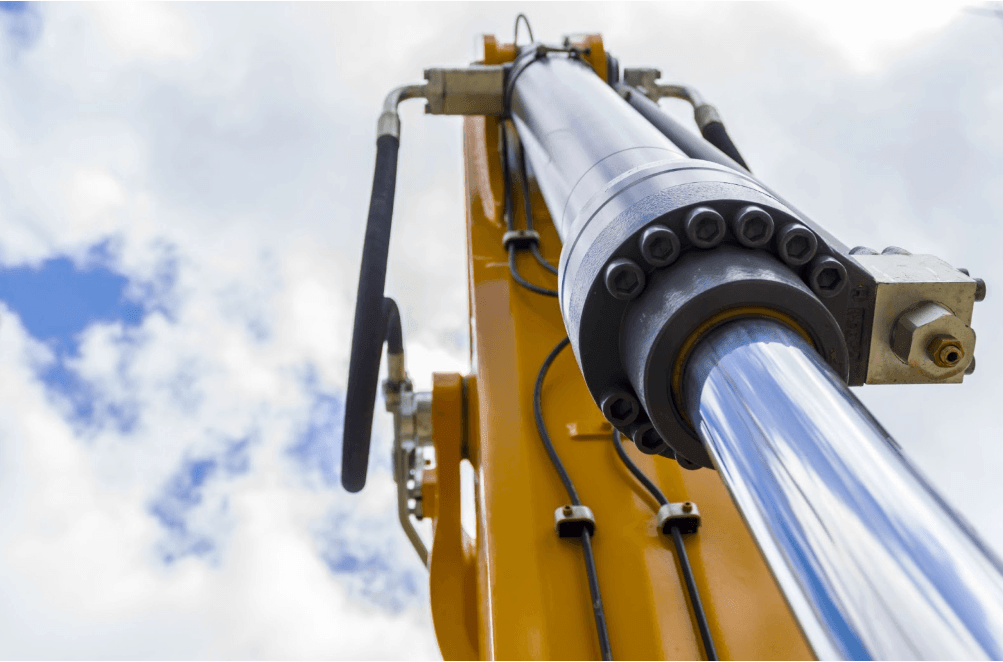
The Three Main Types of Hydraulic Pumps
Hydraulic pumps fall into three main types, each offering distinct benefits for different applications. Understanding the differences between them is essential for selecting the right pump for your hydraulic system.
Gear Pumps
Gear pumps are compact, cost-effective, and best suited for fixed-flow applications. They rely on interlocking gears to move hydraulic fluid, providing consistent flow with minimal complexity. External gear pumps use two meshing gears side by side, while internal gear pumps, including gerotor designs, turn a smaller gear inside a larger ring gear.
Gear pumps are particularly useful in applications requiring steady, moderate pressure, such as agricultural machinery, forklifts, and construction equipment. Because they always deliver the same volume per revolution, they are a common choice for fixed displacement gear systems. They tolerate contamination better than other designs but are generally louder and less efficient at the highest pressures.
Vane Pumps
Vane pumps use a slotted rotor with sliding vanes that press against an outer cam ring, creating chambers that carry fluid from inlet to outlet. They offer smooth operation, low noise, and uniform flow at moderate pressures.
Balanced vane pumps are fixed displacement, while some unbalanced designs can vary their displacement by shifting the cam ring. Because of their quiet, consistent output, fixed displacement vane pumps are common in material handling equipment, hydraulic presses, and automated industrial machinery. HSC also builds vane pumps to order through our vane pump build program.
Piston Pumps
Piston pumps use a set of pistons moving in and out of cylinder bores to displace fluid. Axial piston pumps arrange the pistons parallel to the drive shaft and use a swashplate or bent-axis design, while radial piston pumps arrange them like spokes around the shaft.
Piston pumps deliver the highest efficiency and pressure capability of the three types, which makes them ideal for heavy-duty applications such as construction equipment, mining machinery, metal forming, and injection molding. Many are built as variable displacement piston pumps, which change their output by adjusting the swashplate angle, while fixed displacement piston pumps deliver a constant flow. Their tighter tolerances mean they need cleaner fluid than gear or vane pumps.
Gear vs. Vane vs. Piston Pumps: Comparison
| Feature | Gear Pumps | Vane Pumps | Piston Pumps |
|---|---|---|---|
| Displacement | Fixed | Fixed or variable | Fixed or variable |
| Pressure capability | Moderate | Moderate | Highest |
| Efficiency | Good | Good | Highest |
| Noise level | Moderate to high | Lowest | Moderate |
| Contamination tolerance | Highest | Moderate | Lowest |
| Relative cost | Lowest | Moderate | Highest |
| Typical applications | Agricultural machinery, forklifts, mobile equipment | Industrial machinery, presses, material handling | Construction and mining equipment, hydrostatic drives, high-pressure industrial systems |
Fixed vs. Variable Displacement Pumps
A fixed displacement pump delivers the same volume of fluid with every revolution, so its output rises and falls only with drive speed. Gear pumps and balanced vane pumps are always fixed displacement.
A variable displacement pump can change how much fluid it moves per revolution, typically by adjusting a piston pump's swashplate angle or a vane pump's cam ring. That lets the pump deliver only the flow the system needs, which reduces wasted energy and heat in applications where demand fluctuates, such as mobile equipment, power steering, and industrial machinery with varying loads.
Single, Double, and Triple Hydraulic Pumps
Pumps are also grouped by how many pumping sections they combine on one drive shaft:
- Single hydraulic pumps have one pumping section and supply one flow.
- Double hydraulic pumps combine two pumping sections on a common shaft, supplying two independent flows from one power source.
- Triple hydraulic pumps combine three sections, feeding three separate circuits.
Multi-section pumps save space and simplify mounting on equipment that runs several hydraulic functions at once. This is different from single-acting and double-acting, which describe whether a hand pump or cylinder does work on one stroke or on both.
Other Pumps You May Encounter
Hydrostatic Pumps
In a hydrostatic drive, a variable displacement piston pump is paired with a hydraulic motor in a closed loop, so fluid flows from the pump to the motor and straight back again. Adjusting the pump's displacement controls the motor's speed and direction smoothly, without a mechanical gearbox. These hydrostatic transmissions are common in agricultural equipment, compact loaders, and road construction machinery that need variable speed and high torque.
Centrifugal Pumps
Centrifugal pumps are not positive displacement pumps. They use a spinning impeller to throw fluid outward, which suits low-pressure, high-volume transfer but not powering hydraulic cylinders or motors. They are used in irrigation, wastewater treatment, and industrial cooling systems where moving large volumes of fluid efficiently matters more than pressure.
How to Choose the Right Hydraulic Pump for Your Application
The right pump can improve system performance, reduce energy consumption, and extend the lifespan of equipment. Hydraulic Supply Company offers a full range of hydraulic pumps for different industries and applications. Here are the critical considerations when choosing one:
- Flow rate requirements: Assess the volume of fluid required to maintain efficient system operation. A pump with a flow rate that is too low may cause sluggish performance, while excessive flow can lead to unnecessary energy consumption and potential system wear.
- Operating pressure: Ensure the pump is capable of handling the required pressure levels for your application. Some hydraulic systems demand high-pressure pumps for heavy-duty equipment, whereas others function optimally with moderate pressure levels.
- Fluid compatibility: Verify that the pump materials are compatible with the hydraulic fluid used in your system. Factors such as viscosity, temperature range, and potential chemical reactions should be considered to prevent component degradation.
- Fixed vs. variable displacement: Determine whether a fixed displacement pump, which delivers a constant flow, or a variable displacement pump, which adjusts flow according to system demand, is better suited for your needs. Variable displacement pumps offer greater efficiency in applications with fluctuating loads.
- Environmental considerations: Account for operating conditions such as temperature extremes, exposure to contaminants, and maintenance requirements. Some pumps are better suited for harsh environments, while others require more controlled conditions to function efficiently.
If you're choosing a pump because an existing one is failing, start with the warning signs and repair-or-replace factors in our guide to hydraulic pump replacement.
Frequently Asked Questions
What are the three main types of hydraulic pumps?
The three main types are gear pumps, vane pumps, and piston pumps. Gear pumps are the simplest and most economical, vane pumps offer quiet and smooth flow, and piston pumps provide the highest pressure capability and efficiency.
Which type of hydraulic pump handles the highest pressure?
Piston pumps generally handle the highest pressures, which is why they are used in heavy construction equipment, mining machinery, and high-pressure industrial systems. Always confirm the rated pressure of the specific pump model against your system requirements.
Are all hydraulic pumps positive displacement pumps?
The pumps that power hydraulic systems are positive displacement pumps. Centrifugal pumps, which are not positive displacement, are used to transfer fluids such as water or coolant rather than to drive hydraulic cylinders and motors.
Should I repair or replace a failing hydraulic pump?
It depends on the pump's condition, age, and cost of repair compared to replacement. Our hydraulic repair and service team can evaluate a worn pump and help you decide.
Get the Best Hydraulic Pumps at Hydraulic Supply Company
Selecting the right hydraulic pump is not just about performance. It directly impacts system longevity, energy efficiency, and operational reliability. Whether you're running industrial equipment, heavy machinery, or mobile hydraulic systems, a dependable pump ensures consistent functionality and minimizes downtime.
If you need a hands-on consultation, visit one of our store locations to speak with a specialist. We proudly serve professionals in industries such as construction, agriculture, transportation, and manufacturing.
Our team of experts is available to help you find the right pump for your application, whether you need a high-performance piston pump or a cost-effective gear pump. Reach out to us with any questions or explore our hydraulic pumps today.

Share on Facebook

Share on X

Share on Pinterest
Quick Add Product
Account Summary
Short Code:
Credit Limit:
Current Balance:
Recent Posts
Tell us what you need and we'll get back to you.
Fields marked * are required.
Thanks — your inquiry's on its way